TFJ Vlogs: Bavarian Mood – Metaphysical Backbone


  • In this TFJ Vlog, you will find a discussion of the need to develop physical and metaphysical stamina. Public discourse and effective inquiry require strength and character. Both of these are inextricably tied and I give some quirky examples of how to attain them.
  • Mortality and the prosaic nature of megadeath are mentioned as a call to greater vigor and reverence for the potential lost.
  • There is also some discussion of the environment, especially water, and agriculture and how profoundly it affects our lives.
  • Due diligence must be given to such weighty issues and I just don’t see it being done on a large enough scale. So I raise the need for a more public engagement.

Links

The Poem – Typical (Poem)

Mr. Ramanujan – https://en.wikipedia.org/wiki/Srinivasa_Ramanujan

Banqiao – https://en.wikipedia.org/wiki/Banqiao_Dam

Wernesgrüner – https://www.bitburger-international.com/de/wernesgruener/brewery/

https://www.bitburger-international.com/de/wernesgruener/brewery/


Typical (Poem)

Image result for Banqiao Dam


Opened a book today

A million men died in its pages

A million widows wept, what can I say
A typical account of typical ages

A great river had promise

To make the land rich

They must never miss

The chance to satisfy that itch

Utility’s king

Futility’s felt without building a thing

So goes the ring, so goes the ring

The round circle tight as a noose

Choking the poets

Squeezing the juice

Potential is drained

Yeah you know it’s
The way it’s explained

Very matter of fact

That we must sacrifice

With a haste without tact

For we need things nice

Yet do we really know

What’s nice and what’s ill

What poets, muses, and sages

Are lost in the men that we kill

For the promise of better just slightly
The thing haunts me nightly

So my lamp burns more brightly
Till I see this dross is all gone

Life is a thing both febrile and strong

Both sacred and wrong

So I guard that flame

Doubly sure to maintain the song

For many have died and many are lame

While I have vigor
I’ll recall their name


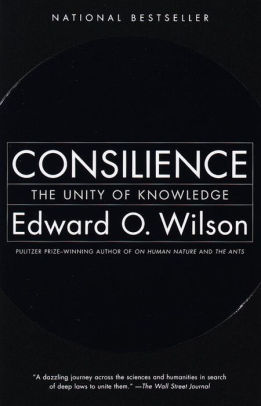
Book Review: Consilience – The Unity of Knowledge (E.O. Wilson)

Consilience: The Unity of Knowledge

Such, I believe, is the source of the Ionian Enchantment: Preferring a search for objective reality over revelations is another way of satisfying religious hunger. It is an endeavor almost as old as civilization and intertwined with traditional religion, but it follows a very different course – a stoic’s creed, an acquired taste, a guidebook to adventure plotted across rough terrain.’

– E.O. Wilson, Consilience – The Unity of Knowledge – Chapter One: The Ionian Enchantment


Introduction to this review: Stray Thoughts Regarding Craftsmanship via – E.O. Wilson’s – Consilience

The Review

Consilience is about consilience, how consilient. That’s the trouble with the word. It’s a bit of a tautology. One of those classifications that point to such a broad phenomenon that it has almost no meaning. It’s like ‘emergent properties.’ Almost everything has or is an emergent property.

I do think these are useful and indispensable concepts. So why do I begin a review by casting aspersions at them?

Well, what’s a review without a bit of taunting and teasing? A touch of play, that’s how you actually keep those austere leather-bound volumes open, rather than having the staid darlings nobly accrue dust on some high shelf.

It is of vast importance to not respect something so much that you never touch it.

For E.O. Wilson the history of humanity, the history of its philosophical, and scientific pursuits has a common thread. Consilience comes from Latin and means something akin to a jumping together. So it is that all knowledge all ken seems to jump together according to a certain logic. It is at such points of convergence that we can become confident in the reality of a given phenomenon and proceed to form a conceptual framework on the basis of this evidence. A conceptual framework which can then be used as a compass to navigate the world of knowledge and make valid predictions. This order this logic is a sort of ‘Ariadne’s thread.’ Allowing us to trace a path through the mysterious labyrinth called cosmos.

Logic itself is a testament to an inherent order that though far more chaotic than the straightforward of ‘fire hot don’t touch,’ is non-the-less intelligible to creatures accustomed to such essential syllogisms.

It is that quest for inherent order for unifying principle that defines the ‘consilience’ concept and serves as the focus of this book.

If one reads the leaflet of the Knopf hardcover edition he discovers a highlighting of this theme:

‘our explosive rise in intellectual mastery’ … ‘has its roots in the ancient Greek concept of an intrinsic orderliness’ …. ‘ a vision that found its apogee in the Age of Enlightenment’

Greece is the focus of the first chapter, in which E.O. Wilson recounts his youthful fascination with the natural beauty of his Alabama home. A fascination that would develop into a sense of mission, the poetically dubbed ‘Ionian Enchantment.’

‘The enchantment’ is a reference to the philosophical outlook of Thales of Miletus, the idea that the universe is intelligible and can be understood once the proper principles are isolated.

One of the great strengths of this book is that Wilson does not let his aesthetic sensibilities cloud his analysis. He readily assents to the difficulty of bottom up analysis, of the synthesis which is at the heart of consilience. Accurately portraying it as a task far more challenging than the more familiar reductionist strategies that have seen much success in the physical sciences.

In Ariadne’s Thread (another Greek allusion) Wilson points out that it is ‘easy’ to go from conceptual complexity to basic physical units. It is an altogether different thing to go from basic physical properties to conceptual complexity.

The myth of Theseus unravelling the ball of Ariadne’s thread in the minotaur’s maze, serves as an apt analogy for humanity’s attempt to make sense of its surroundings. We always find retracing our steps to be easier than finding valid routes through a labyrinth that ultimately has no center.

All we know is that there is something that allows us to navigate, something dear and precious, the yarn of a beautiful maiden that I’m going to take the liberty of identifying with ‘wisdom’ (sic) for the sake of conceptual convenience. This wisdom, this sense of the maze being navigable, is what will eventually allow us something like mastery of that puzzling terrain. Though as Wilson cautions, mastery of such a thing, may not be possible to fully realize.

I’d argue that such an impossibility is actually bliss. It means that the universe is intelligible to just the right degree. So that we may never know enough and grow weary and bored. That greatest joy of exploration will never be yanked from our species.
In fact the more we discover the more the avenues of mystery expand. The future as Wilson points out in the last chapter of his book belongs to synthesizers. People with a sense for consilience who can incorporate information into valid novel coherencies. The universe is thus a vast garden that intelligent creatures like ourselves can eternally cultivate.

This is what makes this book such a worthy read. The rekindling of the classical fire. That flame which was ‘lost’ in recent decades due to the intense specialization that became somewhat inevitable as knowledge and complexity increased.

It is a timely response to the relativism and ‘post modernism’ (sic) of the present age. Which far from providing the fecundity that they seemingly promise have served up something much more akin to stagnation.

I found this book to be a worthy read as a review of the history of science and philosophy through a biologist’s lens. You will encounter in-depth coverage of such perennial issues as nature vs. nurture, the role of genetics in culture, the physical functioning of the brain as it relates to the nature of consciousness, and much more.

The early chapters accounting of the development of the sciences and their underlying methodology has a historian’s flair, that is a timely remedy for the atomization of the knowledge of a ‘common core’ mind.

I’d urge anyone wishing to enrich both their passion and their knowledge to pick up this excellent book.

Retro and the Crow

20180117_135110


What’s the point then?

A computer, a technology, should never be a tether. It should be a tool to enhance knowledge, productivity, and pleasure.

To use a tool properly, one must learn to get by, to get about one’s business without it.

That’s why, post-shower, I am making this hand-written entry with my PC turned off.

There is only the pen, the paper, the ticking of the clock, and the sound of a radio coming from the other room.

Here I am, at my task, the task of writing, with more pleasure, ease, and sentience.

There is no song, no YouTube video, no endless podcast, there are no headphones at all. I do not drown passively among other people’s voices. I select what’s relevant from memory.

I do not fear that my thoughts will be lost, that they will suffer in quality because they are a scrawl in afternoon light rather than coordinates on a glowing screen.

I feel no unease at the knowledge that digitally augmented ken, all the world’s libraries, and forums, are one further step away.

I am in fact as free and secure as the crow that just flew overhead.

Because I have made it possible, more likely to see him.

I have but to swivel in my squeaky office chair to boot the machine. Should I fancy to share my insights electronically.

Perhaps soon I will. But not before I visit a long neglected couch to read a hand-held book.

Such is the exercise I choose to assure a firmer grip upon my faculties.

Through this I find my freedom, my mobility expanded, and my electric bill a touch more modest.


20180117_135253

The Watering Hole (Vlog)


I’m coming at this from a ‘psychological’ angle. This differs from most people’s usual take on our tendency to not look beyond grocery store shelves because I’m not promoting or contesting ‘organic’ claims. This is just a bit of informal speculation on unseen effects of our ‘abstracted lifestyle.’

– Abstracted lifestyle as I use it here is just a reference to the depth and intricacy of our division of labor. We do not take actions or very often come in contact with those that take actions to ensure health and survival on a ‘primordial level’ (food, water, shelter, heat) and thus are ‘abstracted.’ i.e. Accounting and Computer Programming are abstract professions.  


I do not support or deny any of the claims in the following links. They’re presented to help you form your own opinions.

‘Neutral’ (*sic) Info  – https://www.usda.gov/media/blog/2016/05/25/know-where-your-food-comes-usda-foods

‘Pro Organic’ – https://www.cheatsheet.com/health-fitness/reasons-why-you-should-eat-organic-foods.html/?a=viewall

‘Critical of Organic’ – http://reason.com/archives/2002/09/25/i-dont-care-where-my-food-come#comment

*sic is here used in a somewhat unconventional way as a reminder that there is no neutral party of information since it’s all framed by human beings. USDA is by no means impartial or neutral whatever its attempts may be. Not due to any shortcoming on the USDA’s part necessarily but simply the nature of organizations and people. That being said I believe the information contained in the link is about as ‘impartial’ and rigorous as it probably gets.


Here’s more food related reading: 

Forever Fluid – The Strange Case of Renewable Limits (Chapter One – Intro)

Chapter One – State of the Universe? 


Image result for thales

Has Thales been vindicated?

Perhaps this thought is owed merely to my own meager apprehension of physics but perhaps not. In recent times scientists have attempted to resolve two major models of the universe by proposing that it may, in fact, be fluid.

The cosmos has a flow. Groovy. This appeals to the hippie in me. Alan Watts being a patron saint of the moneyed unwashed once said that there are two sorts of folks. Those who believe that the universe is prickles and those who believe that it is goo. This, of course, refers to the famous dichotomy between artists and scientists (and everything else).

E.O. Wilson also touched on this in Consilience, painting the picture of the striving between those who see order and wish to make chaos, and those who see chaos and wish to make order.

Watts in his languid laughing way pointed to the obvious need for both sorts of people and for each person to strive to contain (retain) an admixture of both.

“The universe is gooey prickles and prickly goo!”

The interplay of order and chaos is of course fluid in nature. It is the eternal binary motion, the tick, and tock, that the east has colloquialized as yin and yang.

So yes, in the same way, that water reflects the faces that gaze upon it, it may reflect the core nature of the universe itself.


These are the introductory paragraphs to Chapter one of my book: Forever Fluid – The Strange Case of Renewable Limits

This first chapter should be completed in the next two weeks now that I’ve found some time.

The book itself will likely be published via Amazon or a similar service by the end of this year (or 2019 depending on circumstances). It will likely be an ebook but that’s subject to change.

Thanks for stopping by. I really appreciate your time and hope that I’m able to bring some value to your lives.

Best wishes,

Alex V. Weir

TAP # 10 – Genussiness – Violin Yoga and Death


Don’t you dare skip my soulful karaoke session!
Did you see that smug look! I thought I was being scholarly. There’s no such word as Genossischkheit as per my web query. Nonetheless I take poetic license and dub this Genussiness which is a word for enjoyment without abandon.


Subjects Discussed 

1) Music and how neat it is that instruments are much more readily available due to financing options like rent to own.

2) ‘Violin Yoga’ or using an instrument to center yourself rather than some esoteric practice or as a complement to your esoteric practice.

3) How learning different instruments are good for getting a better feel for music quicker. IMO.
4) Genussiness – the best way to approach life in the context of the knowledge of death. Which in my opinion is using things like art and music to help you live life to the fullest without the opera buffa of being a ‘tragic artist.’ Enjoyment without abandon. The union of the bridge builder and the painter.
5) The environment through the lens of Michael Crichton’s book State of Fear and E.O. Wilson’s book Consilience.
6) How despite having an art friendly culture it’s often difficult to find work and get along with other artists.
7) An attempt to point out how good things are despite the serious challenges I brought up.

Links ‘n Such
Made to love Magic (Nick Drake) – https://www.youtube.com/watch?v=5D1YS…
Consilience (Book by E.O. Wilson) – https://www.amazon.com/Consilience-Kn…
The Yellowstone Environmental Quagmire – http://www.nytimes.com/1994/06/30/opi…
Violin Rent to Own! – https://www.musicarts.com/

Forever Fluid – The Strange Case of Renewable Limits

img_20160828_185033

This is an updated version of a draft for the introduction to my upcoming book: Forever Fluid – The Strange Case of Renewable Limits. © (Originally titled: ‘It Moves You Know’)
I consider it copyrighted, as I plan to publish it, or a version of it as part of the aforementioned book. That doesn’t mean you can’t link or do whatever. Just that you can’t do it commercially and that I’d prefer to know about it.

This book is dedicated to Galina V.W., who twice the mother, raised her grandson as lovingly as she raised her son.

The Case for Care

How does one begin to care about water?  Water being a thing generally only thought about when you’re thirsty or need a wash. How does one begin to care about something that just falls from the sky? Care enough to write a book on it?

Sometimes life’s projects spring out of nowhere. That is until you take the trouble to track ‘em back to their source.

This particular endeavor may have started when Doctor Walter (Pseudonym), my HS Earth Science teacher, mentioned that water might become an issue in coming decades.

That idea sat in the back of my mind for years. Dormant and drowned out by all the usual business and distraction of being a young man. It wasn’t til I stumbled upon Consilience, The Unity of Knowledge, nearly a decade later, that I was reminded of the reality of limited resources.

Consilience isn’t an environmental book. It’s more one of those intellectual adventures. The sort that scientists set out on when facing the seductively beckoning sea of life’s mysteries. Consilience is biologist E.O. Wilson’s ‘all-in-one’ foray into the history of philosophy and science. It’s a highlighting of how this history reveals an inherent overlap, or ‘jumping together’ of knowledge from various disciplines. One that occurs in concert with his own insightful musings, on how such consilience may soon more fully occur. Though I disagree with much found in its pages, I’d highly recommend it as a fascinating read.

The work’s pertinent part for this particular project came at the end of the book. Which at one point discusses the vast expenditures of energy and resources necessary to sustain life today. Discovering the sheer amount of water involved is what triggered the memory of old Doctor Walter’s cautioning.

This recall and its attendant realizations are the reason for why I learned to care about water and why I wish to impart that care to readers of this book.

Care is often stigmatized by the twin burdens of trouble and responsibility. Yet care can also be fascinating. It can in fact be a great deal of fun. It can animate certain dormant sensibilities, that nourish and revitalize the spirit, and lead you to myriad adventures and discoveries.

Another natural consequence of care is of course cultivation. Care leads to the cultivation of spiritual, intellectual, and physical powers. Powers that are indispensable in the most precious and precarious sort of cultivation. A cultivation called agriculture and industry. Twin disciplines upon which all of our lives depend and which are in turn wholly dependent on water.

There will be much on this in coming chapters. For now I ask that you be so kind as to humor my penchant for introspection.

Catalyst

Lord, how our information increaseth. (Keith Waldrop. Transcendental Studies: A Trilogy)

I like to introspect. I find it to be an excellent exercise for developing strong creative and critical thinking faculties. These skills have always been essential. Perhaps it is a mistake to say that they are needed now more than ever. But, I’m going to say it.

I’m saying it because although the world is as complicated as it always was, we are more complicated than we have ever been before. The machinery and administration of our societies is vast, labyrinthine, and interdependent. For these reasons, and perhaps ‘just because we can,’ we developed the ability to communicate instantly across oceans and continents. As a result information bombards us at an unprecedented rate.

Lord, how our information increaseth. Indeed.

Our familiar manner of relating to one another, of interacting with the environment, and the ‘qualia’ of our institutions have all undergone drastic changes.

All of these things call for well developed faculties. It will take strength, wit, compassion, and resolve to continuously thrive in a world of 7.6 billion people, large hadron colliders, and dead zones. It will take introspection.

This is why I weave psychological, philosophical, and sociological analysis into a basket, that would already be complete, even if assembled from the barest essentials of science and reporting.

I would not be able to practice such a delicate art. The art called ‘integrative analysis’ without a healthy dose of introspection.

‘Integrative analysis’ is the multifaceted discipline foreshadowed by the catalyst for this work: E.O. Wilson’s Consilience. It is consilience.

Nowhere is it more necessary than today’s interdependent, overlapping, high speed world. A world that produces words like Biogeochemical.

Biogeochemical should have been the watchword of the 20th century. The passage of chemicals between living things and the environment is a cycle that requires rapt attention. Perhaps if such attention was given there would have been yet more geniuses and poets. There is much to unpack in the latter statement. For the purpose of the introduction I will simply say: Preventing illness and death is why we must strive to make Biogeochemical the watchword of the 21st century.

The very nature of the word is multifaceted. It is a testament to the increasing complexity of living in a universe that is inherently, unfathomably intricate. It is why I practice and stress the need for developing a strong capacity for integrative analysis.

I think it worth mentioning that good analysis requires hard work and resolve. Neither hard work nor resolve are possible if you fall into the trendy nihilism that’s still somewhat in vogue. This nihilism has at its core a bizarre sort of overdeveloped minimalism. It is a bastardization of utilitarianism. One that has kept me, and I dare wager a good deal of others; from accessing the energy, resources, and will necessary to fight the good fight.

It is in the interest of providing an example of how this mindset plays out and is resolved that I offer the next passage. I do so in the hopes that it will produce more authors, more cultivators, more passion.

Fortuitous

It was recalling Doctor Walter’s words as I was reading Wilson’s work that led to this present volume.

This recall came at a fortuitous time. That is if you consider the creation of a book fortuitous. I was looking for something to do. I knew that I had to do something. I’d spent too much time looking and studying and not enough time doing. I weighed the merits of various enterprises and remembered that I’d always intended to write.

While, you’re welcome to disagree with my self-assessmsent. Writing is something I consider myself good at. Words and ideas come with ease and coherency. Something more the result of having a love of reading instilled in me early than any inherent braininess.

The fact that writing came naturally, the idea that books didn’t have utility in the same way an algorithm does, and the saturation of the writing market; are some of the reasons I viewed a writing career dimly.

I needed to get a ‘real job’ and build ‘real skills.’ Not do something that was ‘easy’ and fun. I bounced about from odd-job to odd-job, attempting to teach myself computer programming, because things have to have ‘utility’ you know.

Rediscovering the water issue was a fortuitous catalyst. It was an issue that my skill could shake a stick at. Even better it was an issue that had utility.

How does writing solve issues? Well, it doesn’t but it may help along the process. (The very fact that I feel the need to say this is testament to the trendy utilitarian nihilism mentioned last section.)

Part of solving a problem is having a good grasp of it and that only comes from thinking. Writing being formalized thinking seems perfect for the job. While I may not solve anything per se, I can serve as a signpost for professionals and laypeople alike.

The Flavor

Many readers pore through the introduction to see if a book is up their alley. They’re always trying to get a taste for the flavor of it. To see if they like it.

I’ll flat out save you the time and give you a taste.

It is true. Every book has a flavor. This book is no different. It will take you on a journey through the fascinating intersections defined by the axis resource known as water. It will be both a lesson and a story.

This is my first non-fiction book. It is narrative journalism. According to thebalance.com narrative journalism is:

“An immersive style of storytelling, narrative journalism is used to captivate readers by drawing them into a story with greater detail than is found in traditional news stories. It is a popular format for magazines such as the New Yorker and can difficult to define and write.”

I love stories, I love finding things out, and I dig a challenge. So this medium seems exactly up my alley.

I don’t think that any of the above traits are special. They’re up everybody’s alley. There’s a lot of joy to be had in reading a hard-won story about the real world. It’s a joy that’s on par with creating the story. One that I was delighted to experience as I did the background research necessary to launch this project.

The works of Alex Prud’ homme, Fred Pearce, and Jacques Leslie. Works like The Ripple Effect, When The Rivers Run Dry, and Deep Water are all superb examples of narrative journalism.

This book is written in a similar vein.

A Little Extra

Since the New Yorker was mentioned, I’d like to suggest that my readers whet their appetite for narrative journalism, by reading The Lost City of Z by David Grann. It is free to access on their website.

The spirit of exploration is one that I’ve always held in high regard. A flame that needs stoking, in a world that believes it’s been mapped and mounted, like some hapless gossamer butterfly in a Victorian collection.

It is in the interest of rekindling such time-honored passions, that I began writing a jungle adventure inspired by all the Doyle, Crichton, and Lovecraft I pored over in my adolescence. (Of course Alan Watts and Terrence McKenna played a role as well.) Researching for The Sketch of Sam Monroe (estimated completion: 1st Quarter, 2019 ) led me to Grann’s article. It is a worthy read.

If you dig jungle books, and aren’t too uncomfortable with salty language, and psychedelic silliness, please check out the intro and first couple of chapters on my website: fractaljournal.com.

I believe that jungles are useful metaphors for getting to grips with things and for kindling the spirit of exploration.

Getting a grip on the water issue is a jungle in its own right.

Time to set up base-camp!


© [Alexander V. Weir] and [fractaljournal.com], [2017]. Unauthorized use and/or duplication of this material without express and written permission from this site’s author and/or owner is strictly prohibited. Excerpts and links may be used, provided that full and clear credit is given to [Alexander V. Weir] and [fractaljournal.com] with appropriate and specific direction to the original content.