

Classics and the True Way

Schmoll_Goethe_Va

It was either Goethe’s Werther or Wilhelm, that provided me with a certain sense of balance. I’d never really read the books except as exercises in seeing how much I could glean with my sparse knowledge of German.

It was a secondhand account, either in a book or in some online posting that I gained some familiarity with the plot and style.

I’d taken an interest in Goethe after stumbling across Blixa Bargeld while listening to internet radio a number of years ago. I’d already been steeped in Nietzsche, as every edgy teenager should be, and thought it would be fitting to add another dead German to my Trane of pretensions.

Blixa’s rendition of Wanderers Nachtlied (Ein Gleiches) is very good but the poem is even better. It’s sparse and stuffed with ponderous depth. Something I’ve come to expect from all things German.

Bach’s genius I think lies in taking something very simple and making vast frescoes and stuccoes out of it in the uncanniest of ways. I’d already been pretending to be fond of Bach for years. So all the pieces of how I thought an antiquarian revivalist should behave had fallen into place.

When I say pretension I do not mean it a negative way. Although there was some ulterior motive in that I was struggling to set myself apart. This instinct for differentiation common when crossing the bridge from boy to man was well served by my choice of subject.

Classicism is life. Classicism is the lodestar that guides one to the True Course. So when I say pretension is not negative I mean that there is absolutely a necessity for everyone to assume an affectation. Today’s ‘authenticity’ with its blue jeans and four chord ballads is itself an affectation. One can choose to don it, or cast it aside in favor of another, but either way, the choice must be made, and it had better be a good one.

Certainly, those who prefer the bold-mans affectation will feel a bit stifled by the tried and true sure bet of classicism but I think this would be a misreading. Just like one can’t really play jazz without being well versed in the rules that need to be broken one can’t really be an adventurous man of action without knowing from what it is he is departing.

Alan Watts described classical music as being the purest expression of music for music’s sake.* I don’t think that it would be a mistake to say that he found classical music to be tres Zen. I happily agree with his assessment.

Wu Wei is the True Way and Classicism is the best of affectations because it is the ultimate falling into place. The sense of solidity that one gains from something obviously good, from something that is Der Ding An Sich, is not just an accident of custom. It is not something that we relish and cherish simply because it is old.

No. It is old and remembered because it retained the most salient features of the human experience in the most efficient way possible. This is the reason why I call it the lodestar to the true course because those who don the affectation of Classicism will be able to forge new paths. Paths that last. And even if one does not forge any new path one will be fortified by an acquaintance with transcendent beauty that will make even the dreariest of circumstance bearable.

Today’s obsession with novelty and authenticity seems to produce nothing but remakes. Those who most proudly proclaim progress and define themselves as acolytes of the future are stuck in the past feeding on bread that’s decades stale.

Why is it that the seventies, eighties, and nineties produced so much that was so new and so full of depth? Because those generations were still steeped in classicism. They had good models from which to diverge. Today we merely have the echoes, of the ghosts, of what they built to rely on.

There is much that I like about today and there are still amazing artists, philosophers, and scientists and I don’t think it needful for everyone to mutter over Virgil to make valid and beautiful contributions. However, a bit of Virgil would certainly help.

Just the hint of what Goethe was getting across has helped me to gain a surer footing and be productive as a writer and amateur musician. Not only has it helped me in these regards but it has helped to cement my purpose and sense of what it is to not only be a man but a human being.

Some web searching being in order I found the thing that had been transmitted to me through the hint of Goethe: Entsagung. A word which roughly translates to renunciation. Renunciation of what exactly. I think a renunciation of swaying to and fro. I think that perhaps a more fitting term would be resignation. Resignation to what? To Wu Wei, to something like the Tao, or what have you, if you will.

So the thing in itself, Der Ding an Sich, Art pour le art, etc. is simply the purest expression of what is to be human and is grasped when you have the balance you get, from Entsagung, a balance that allows you to see loading trucks as fuel for writing poetry.

The classics in whatever form, whatever genre, will never be forgotten. For it is through their cardinal points that we find Wu Wei that truest paths…

A path lined with columns, arches, and flowering gardens of the most sublime craftsmanship hinting and singing of the most profound depths that lie in even the commonest of things.

* Alan Watts wrote several books and delivered many lectures so the specifics of the attribution may be a tad off. I’ll attempt to either rectify or supplement this information when I get the time.

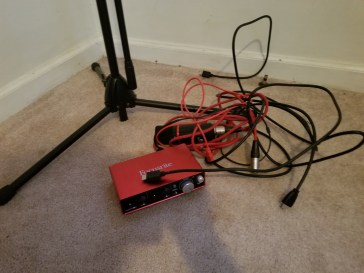
Image result for ancient compass

Waiting for Jill


O my. I fear that I am becoming the master of hackneyed points. So be it.

The little hobbyist recording kit I’d bought about a year ago still has a short in it. I’m sure the company would have honored the warranty if I’d sent it in, but I’m terribly bothered by even the mildest of bureaucratic tasks and haven’t fetched the information necessary to do so.


20180101_170915.jpg
Affordable and works well when you treat it right. 


That’s why I made the video. Well, sort of. It’s part of the reason. I also just enjoy sharing my thought processes and certain “authentic” spur of the moment little events.

I really fancied the silly little vocal melody and lyrics that I’d come up with and didn’t want to forget the cadence, pitch, and rhythm. So I thought I’d record it. Given how my phone is currently my mic and camera that’s what I used.

My dog being the nosy pest that he is decided to burst in, which added to that sort of spontaneity vibe and I thought, ‘Hmm… why not just post this.’ Maybe it’ll give someone a few moments of amusement.

Most of all though, it allows me to do my favorite thing which is pontificate about creativity and process.

I think most musicians and songwriters are too busy with the act of creating and recording to bother to share their thoughts on the matter too often. How fortunate that I’m primarily a writer and philosophy nerd. This means that I analyze the ever-loving hell out of absolutely everything for what I hope is your enjoyment and edification.

I think the fantastic thing about things like the story of Jack and Jill is that they are these little archetypes. Not so much of a particular concept like ‘the maiden’ or the ‘wise man’ but more about the vibe of a thing. They transmit a certain plasticity which makes them wonderfully malleable items for the formation of lyric and poem.

All I had in my head was the name Jill for whatever reason and then obviously Jack and the blasted hill entered in by association. Generally, such nursery rhyme things evoke memories of blissful childhood, best represented by ‘the moment of sunshine,’ and so I had myself a theme and little lyrical bits I could assemble into a coherency.

Obviously, the familiarity of the story also means that it’s likely primed for a warm reception in the mind of the audience and artist alike.

Yes, there may be some contrarian hipster sorts who’d balk at something so mainstream. However, perhaps they can fall under that ‘ironic’ spell of something so bad (by virtue of hacky premise) that it’s good.

Although, now that I think about it…maybe Jill wasn’t on my mind at all. I think that I’d wanted to go to my favorite meadow in the local wood like the dirty hippy I am. Out there is where I like to soak in the sun, as I read things like Emerson, and mock myself for the fact that I actually unironically own a hacky sack. In these moments where I’m alone in solitude, I realize, that although it is a happy solitude, I am waiting for something, longing for something.

There’s a lot to long for and wait for in a universe of infinite possibilities. But one of those things which is most tangible as a representation of them all is the lover. So perhaps it was the archetype of the maiden that spurred me on all along.

I felt especially happy that the name Jill entered into my head as a result of that ‘x variable’ that was necessary to get across this crunchy vibe. Its puerile simplicity is a wonderful foil, or background, to a concept that could be weighed down by a lot of cosmic portents which would render it unfit for my current purposes. I wish to convey happy expectation not...SEHNSUCHT

So, I hope that you’ve found this to be as fun to read and watch as I had in writing and recording it.

Thanks for stopping by and have a great time wherever time finds you.


Jobs, motivation, and cartoon squirrels.

I’m fond of the Foamy series which I’ve been watching since I was a teenager. I find that this episode I just stumbled across fits really well with the theme of some of my recent posts.

There’s sometimes a bit of language and risque stuff in these cartoons so be forewarned.


The idea of working hard for yourself rather than a company that doesn’t treat you right is one I’m on board with. But as I pointed out in my post on loving uncertainty you have to temper that feel good notion of entrepreneurship with realism, diligence, and flexibility.

Hope this was fun, helpful, and cathartic cause that’s the intent.

Cheers.

Birdie’s Window and Did Crichton Float?


I do a song, and I’m going to be doing book reviews, so I thought I’d start with Sphere.

This Michael Crichton classic is one of my favorite reads and I only just now noticed how it may be related to a float tank experience he may have had. Feedback is always welcome and thanks for stopping by.

– Addendum: “After trying out several models, Perry settled on a tank that used 10-inch-deep water saturated with Epsom salts. He and his wife Lee opened a float center in Beverly Hills in 1979, renting out their five tanks largely to entertainment industry types. Michael Crichton came in to float when he had writer’s block. Eventually, Crichton bought a tank of his own.”

http://www.slate.com/articles/life/anything_once/2013/05/sensory_deprivation_flotation_tanks_i_floated_naked_in_a_pitch_black_tank.html

Nerdy Delights for Crichton Fans (everyone else too! good stuff here.) 

http://primate.uchicago.edu/2008Crichton.pdf

Instant Uploads and the Death of Magic?


I do a ramble about how the way that music and art are framed, in this case via recording medium, drastically effects perception. As well as raise the question of whether the ease of upload effects the process and magic of creating new songs.

I also play a little ‘song’ I wrote which is just three or so chords and these lyrics:

My mellow sunshine

Showed up on time

My mellow sunshine

Dropped me a line

My mello sunshine

Pulled me on through

My mellow sunshine

With eyes of blue

I remember sitting I remember dreams (I remember grinning) I remember smiles and miles

I remember I remember All from the beginning

When my moon was highest

When the night was cold

When the taste was driest

When the song was old

My mellow sunshine

Showed up on time

My mellow sunshine

Dropped me a line

My mello sunshine

Pulled me on through

My mellow sunshine

With eyes of blue

A faded couch Nicotine nerves I’m here to vouch

That none better serves

Than to see the sun in moon

To correct the spell

Quell the monsoon

Of aught Of naught Of never

With Yes And Now And Forever

When…

My mellow sunshine

Showed up on time

My mellow sunshine

Dropped me a line

My mello sunshine

Pulled me on through

My mellow sunshine

With eyes of blue

The Sort of Cold

kjk


Oh no. The common workers’ dilemma. What the hell is this tickling in my nose? Oh,  it’s now a burning in my throat.

Well damn, it’s not too bad. I have a pretty good immune system. I guess I’ll go to work, wash my hands often, and won’t stand too close to people. There are bills you know.

This mini-episode of sociopathy and desperation is pretty common and indicative of the sort of society we live in. Sure you could talk all day about personal responsibility but life costs money and people get sick and sometimes they can’t afford to be sick. What can be done? I don’t really know but I think it’s worth mentioning.

What I can do, besides just bring it up, is offer ways to proactively deal with the bummer of the ‘sort of cold.’

The first thing you can do is view these mini-maladies as practice. Honestly, I sometimes get suspicious if I don’t get just a little bit sick at least once a year. How else am I going to know that my immune system is getting a workout? I don’t know how wise or scientifically sound this hypothesis is. But, it seems at least to be a better tactic then getting upset about sickness.

It is possible to lose your temper at common cold. I think that I have pretty good grounds for getting upset about it. Aside from the occasional double pint night or go at the cookie jar I’m pretty healthy. I exercise regularly, I eat a more or less balanced diet with an emphasis on protein, I make it a point to get enough sleep, and I have decent hygiene.

WHY AM I SICK? I could get justifiably mad about it but that’s not productive. Obviously assessing the nature of the illness, recovery plans, whether you need a sick day, or a doctors visit are the first steps you should take.

My two cents here is a tad more philosophical. It has to do with outlook.

The second thing you can do aside from viewing colds as practice is letting them inspire you. Sounds odd but it works. Due to a combination of luck and effort, I can generally remain feeling pretty great most of the time.

What happens when you feel strong and enthusiastic for a long time is you can lose touch with mortality and your vulnerability. This state produces complacency. A complacency that’s very helpfully broken by the common cold.

If you’re used to feeling well and are suddenly sick, even a little, it can be jarring. Jarring enough to inspire you to redouble your efforts at being healthy and strive to be vigilant about your vulnerabilities.

A good use for illnesses that you are 100% sure are gonna pass in a couple of days is to realize that they could be much worse, that they could be cancer, or diabetes, or dementia. Musing on ‘an even worse’ case scenario will inspire you to take the preventative measures we are all familiar with more seriously. It can inspire you to do more background reading and to be more sympathetic and understanding of situations and people because you’ve contextualized life as the complex and vulnerable thing that it is.

The third and final strategy that I’ll mention before I make a beeline for my coffee/honey/milk-fix is the trite but true method of letting sickness kindle a greater appreciation. A greater appreciation of what exactly?

Well, obviously of your health when you have it, of the fact that things work as well as they do in a world where something you can’t even see can kick your ass, and of the fact that you have the means to recover. I for one, due to avid reading, and some experience with slightly less than first-world conditions, am ecstatic as hell that I can munch on frigging pineapples, chocolate,  drink milk, and enjoy honey in December while exploring the world with keystrokes in a warm, dry, clean and well lit little office. I am also greatly appreciative that even if I am an odious toad and risk getting my coworkers slightly sick they’ll understand cause that’s how I got the cold in the first place.

Generally though, avoid going to work or even near family when sick. I only risk these things because I can knock out a could within thirty-six hours and think that whatever that slight burn is, is just the devastated phalanx of micro-organisms who chose to mess with the wrong Barbarian horde. This is already a bit silly but sometimes we can’t avoid silly.

Hope these tips have helped and use your own discretion. May your celebrations be bug-free and Happy New Year.

Learn to Love Uncertainty

sunset-401331_640


Learn to love uncertainty.

That’s the best advice that I feel anyone can give. Especially today. Alright, so maybe not especially today since in a lot of ways today is more certain than days when you could get killed by the flu or pirates.

Yet, today is still precarious. While the uncertainties may be far more subtle than starving or getting mauled there may be a greater variety of them.

One such uncertainty is job security.

There are many popular voices today that upon seeing mass migrations, automation, and all sorts of economic shenanigans reflexively begin to espouse the virtues of entrepreneurship.

While I think that entrepreneurship is a fine thing, I also think that one of its core pillars is more important to highlight. That pillar being initiative.

Initiative is what will allow you to navigate uncertainty.

Before you can navigate uncertainty you have to want to navigate uncertainty. This means learning to love it.

Fortunately this loves come naturally, at least somewhat. Despite uncertainty’s membership in an acronym that marketers use to sum up difficult targets (FUD – Fear Uncertainty and Doubt) uncertainty is thrilling. Uncertainty is vital because a sure thing is generally a boring thing. The addicting nature of gambling bears testimony to our innate love of uncertainty.

The aptest analogy for uncertainty is probably the open sea or if you want to get a bit more modern open space. I think that it can be argued that gazing out at the ocean produces a fairly consistent reaction. That being excitement, wonder, and the desire to explore.

Yet, even in days and cultures where sailing was common and promoted as a great virtue not everyone sailed. Why?

Because not everyone learned to love the sea. Not everyone learned to love uncertainty. The infatuation with the idea and romance of seafaring is not the lived love of spreading actual sails, braving actual storms, and overcoming your aversion to such things.

This is where the point of this little essay comes in. Why would somebody have to learn something that comes naturally? What does any of this have to do with work and navigating modernity?

Because it is only the beginning of the thing that comes naturally. Because the world of today is as fluid as the ocean and our social institutions, means of relating to each other, professions, and technology require the deft navigation that you can only master by learning to love uncertainty.

Loving uncertainty will teach you the need for initiative. It is the expectation of challenge and the unknown that will drive you to make the adequate explorations and preparations needed to succeed in an uncertain world.

A favorite lesson that I learned from Alan Watts comes into play here. It is the lesson of the benefit of perspective. Of not seeing yourself as lost in a maelstrom of causality but as an integral component of the great happening. This perspective allows you to see that the hard ground is holding you up, that the hill that’s in your way is taking you higher, that your hunger and fatigue are keeping you alive by pulling you towards seeking out necessities and thus appreciating their satiation all the more.

Uncertainty is the firm ground that’s lifting you up, it is the rain that though at times cold will make that ground fertile, and learning to see it in this way is a psychological tactic that I believe is essential today.

It is essential because it teaches initiative and it teaches love. The whole reason that I pluck the word initiative from the entrepreneurship concept is because it is a principle.

Entrepreneurship you see is a practice, a very specific practice, and one whose successful execution requires a host of skills and realizations.

Principles are much simpler and more essential things which make entrepreneurship possible.

If you have the prefabricated notion that you must become an entrepreneur then you run into the problem of fitting into a mold. You are limiting yourself in the same way that you would by trying to squeeze into a pair of skinny jeans cause they’re hip.

Running a business, a website, programming a game, or opening up a Cafe are all entrepreneurial pursuits which may or may not be a good fit for you at any given time. Holding any one of them or even the more nebulous notion of entrepreneurship as concrete goals may be premature.

Before you begin any of these ventures you need to learn to love uncertainty and take initiative. Starting with a simple physical job while seriously pursuing a creative or academic project on the side is what I’ve found to be best. There is something in the instant feedback and relatively small number of variables of simple manual labor that is absolutely incredible for building the skeleton of timeliness, sequencing, and stamina. You of course still have to be seriously pursuing your creative or academic project.

By academic I do not mean college or university. While those institutions do have value I think it important to point out that one can do serious scholarly work on ones own. Especially with the tools and resources available today.

Staying out of the restricting mindset of becoming an entrepreneur, or needing this or that career, or this or that degree is exactly the sort of embrace of uncertainty that I’m trying to get across.

First learn the initiative of getting things done in a timely manner, of making sure that you are able to provide you and perhaps others with resources, and learning what you love and value.

Entrepreneurship, or a law practice, or a degree in anthropology will I think come more naturally and painlessly with this mindset.


This essay has been mulling about in the back of my head in various forms for a while, and is finally brought forth because I had a firsthand encounter with uncertainty just today.

I’ve taken on seasonal work to pay some bills. Today, there was a surplus of people and a lack of work for them to do. So a couple of us got the day off.

This got me to thinking. Suppose that this was my only idea of income, my only idea of how to make my way in the world, this would make me very nervous perhaps even a little panicked.

Sometimes seasonal work is all that’s available, sometimes law graduates work at cafes, I actually recently ran into a female programmer who is now waiting tables because she got laid off.

These things are testaments to the dangers of certainty and not taking initiative. I am not saying that people that got laid off don’t have initiative or got too comfortable. I’m saying that culturally it is altogether too common to rely on institutions and credentials as if they’re always going to provide us what we need.

I think that many of the folks that comprise these companies and institutions have excellent initiative and understanding of uncertainty but I think that we need to start to stress the need for yet greater initiative and understanding. We need to start to develop practices that foster flexibility and reflect the increasingly fluid nature of class and demographic dynamics.

I have not provided a concrete set of practices in this essay but I may make the attempt later and think that I at least made a decent crack at conveying the requisite ethos.

Some might think this to be dreamy, overly philosophical, and flowery. Perhaps in some ways it is. Perhaps some think that this was merely writing for the sake of writing. Yes, that is true, at least in part. I decided to sit here and type this out not only because I think it is useful and entertaining enough to be shared but because I need to practice writing. I think that this is a good example of living out the ethos of initiative since I could just as easily have watched 90 minutes of stand-up.

I hope this was helpful and thank you for reading.

Dead Bunny – An Uncanny Memento Mori

“The sensibilities of the hunter and the poet…” (Consilience – The Arts and Their Interpretation, page 237. Knopf)


20171225_170054.jpg
 I made it as small as possible because I don’t want to bum out the gentler sorts. But yes. This just happened. 

I did feel a bit like I was hunting and that I had been successful. The universe, that vague thing we allude to when we want to convey the sense of a unifying and pervasive force, can surprise you. I’d been musing on the fact that trying to rush things leads to bad results. Haste makes waste, you know the old cliché.

Some trite things are true. This itself is a trite and true observation and I’m not trying to wow anyone with it. It’s just sort of necessary to get to my point.

There’s a Latin phrase: Memento Mori. It was something said to victorious Roman soldiers so that they would remember their mortality and not get overconfident. At least that’s how I recall the thing, and I can’t currently be bothered to look it up, because its Christmas day and I have work in the morning.

I went out for a stroll and fell into a bit of a reverie in the chill December air. I was thinking ‘you know there could have been so much that I could have already done in terms of a completed work.’ Why hadn’t I? Wasn’t it because I didn’t hustle enough?

No.

It was because I hustled too much. I’d missed the boon of impetus that Mercury delivers to the attentive. I’d heard it as a whisper and instead of listening more closely I’d attempted to shout back the rumor for confirmation.

Or maybe this is just me losing my point which is that it is very uncanny. It is very uncanny when the universe, that vague thing we allude to when we want to convey the sense of a unifying and pervasive force, puts a dead bunny on the path of your Yule Tide walk. Just at the moment that you are thinking about haste and death.

There are those who dismiss most everything as a coincidence I have at least a dozen teasing things that argue otherwise.

I do not mean to be morbid during the holidays. I suppose I should dispel the funk of death by explaining my view of it. Yes, the poor dead hare is leaping no more but such is the fate of all the things under the sun and it is not a bad thing. It is not a lingering illness. The physical life animate on this sphere is a song worthy of singing. But should one wish to sing the same song forever?

That bunny now knows eternal rest, and in his dusty bed, I read a poem that told me life’s completion lies in going at the right pace.

What is the right pace? I am still trying to figure that out but I think that the answer to this riddle could be that there is no pace at all.

I may be straying into obscurantism but that is not my intent. My final guess is that you can only gain the proper pace by listening to the cadence.

What is the cadence?
Perhaps we all know, perhaps we all don’t, whatever the case I hope the new year finds you well.

TAP # 9 – Intermittent Fasting and Loop Control


I get loopy. Talking about syncing up your steering wheel with your gas pedal. These are sites that I consider to be fairly well sourced and reliable: That doesn’t mean I agree with or endorse everything they say. Simply that they are a good place to try and expand your knowledge. Remember to think critically. – http://roguehealthandfitness.com/https://chriskresser.com/

Man of Letters

Image result for creel factory


Der Ding An Sich

It really stuck in my craw. I remember standing there in front of the machine. It was a bizarre twenty-first-century machine still quaintly termed a Creel. My boss, the surrogate father of my room-mate and prep school buddy was telling me something I found hard to fathom.

Not that it was difficult. There is nothing difficult about machines. The chief difficulty is generally that they’re a tad dull. Doubly dull on days when you’ve awoken before the sunrise to drive from a one bedroom apartment, past listless trees and lumbering rigs, to a grey gravely yard next to a utilitarian affair termed a factory.

“You’re a man of letters.”

It really stuck in my craw. I’d asked for a guide. For a chance to study the inner workings. The simple buttony operation of the thing would stick better with such documentation. Yet instead of encouragement for my interest, I was called a man of letters.

It is odd for me, it is profoundly difficult, to keep from resenting soft suburban blindness. To deal with the oversimplified dichotomy of ‘this’ and ‘that’, and ‘thus’ and ‘so’ of the collegiate. I was not cradled there, I did not belong there, and I certainly despised being called soft by its tenderest tenants.

This whole essay is years in the making and the flame animating the long assembled kindling was sparked by ‘the most widely known man of letters.’ Ralph Waldo Emerson, yes finally I had an elegant way to broach the subject.

The Internet Encyclopedia of Philosophy contains that little phrase. I was there because Emerson is the great Ghost behind our present machine. For good or for ill.

I think good and ill a thing that’s at times difficult to fathom. Though not as difficult or impossible as my ‘post-modern’ (relativists)(sic) contemporaries would make it out to be.

Emerson thought the man of letters was incomplete. Like Aurelius, he thought that muttering over books overlong was unhealthy. I’d been conditioned from youth to agree with this assessment.

A far more recent writer by the name of Crichton had shaped the entirety of my ethos in the span of a paragraph. In a dime-store thriller called The Lost World, there was a passage lamenting the academics penchant to be maladapted. This need to be nerdy was sharply contrasted with the athletic achievements of some 20th century Noble luminary. I think it may have been Plank.

I was thin, and pale, and dark. I reveled in the hills, streams, and woods of the nation that adopted me. My father was a security guard who participated in martial arts tournaments. My mother worked in a gym in the basement of a looming thing in the metropolis of my birth. My father’s father was a gym instructor. My grandmother’s father was a geologist or economist for a geological survey studying some of the roughest country on Earth. So despite being thin and pale, and dark I had a physical pedigree and physical passions, as well as not the cheeriest of childhoods.

All these being reasons why I so thoroughly imbibed Crichton observation, and so thoroughly resented condescension from first world humble braggarts.

These sorts steal my time, steal their own time, and stymie this wondrous blooming thing called life with listless labeling.

This is why Emerson is so essential and misreading him so dangerous.

He is called the ‘most famous man of letters’ by that Encyclopedia for solid reason. He is both hapless signpost and robust director of the American way. A decent and dare I say lovely path when properly taken.

‘America is a poem’ and the magic of poetry is in its motion. Rhythmic meter is the same animus that Emerson promotes by suggesting that a man see no work as beneath him, so long as it is useful at the moment. He saw the enlightenment sought for by all the sages in all the ages as being possible to accrue from the most mundane of tasks, provided the proper spirit.

Logos and pathos, Apollo and Dionysus, in perfect concert that’s the ethos. At least that to me is the ethos Emerson was attempting to transmit.

Transcendentalism you see is not about escape but about embrace. Individuation and individualism are not about isolation but realization. The proper reading of individuation is not of setting apart but of standing together. Yes, we are together but we do not lean one against the other, each of us stands upon the same ground and we regard each other as one regards a magic mirror. In this realization, the mirror is a window into another world where we see ourselves in a different reality. This embrace is the kindest Agape and the richest kiss of Eros.

Of course, to use a cringy cliché this rose has many thorns and plucking it requires utmost caution.

“Rich man in a poor man’s clothes.” To borrow from Elliot as I will do forever is the prickle that I find most personally irksome. The humble braggart, the latte-swilling tough guy, the ‘dude with a stilted attitude learned from TV,’ the man who called me ‘man of letters.’

Why all this ire? Was it an insult or compliment? Was it both? I do not know but I do know that it is indicative of an improper digestion.

Emerson, unless I am mistaken would have resented the separation of the ‘gritty blue jeans realist’ from the ‘man of letters.’ In fact, I think that he found this very dichotomy to have a mortifying effect. It is the same dichotomy that Crichton and Aurelius address when they remark on the imbalances of certain characters. So, to be called ‘a man of letters’ by a hard-working dandy, seemed indicative of improper digestion of the massive cultural morsel, that the Transcendental school has set upon the American table.

I’m not exactly sure what they’re playing at. What they’re playing at with all that cocky grinning, armchair psychology, beards, and flannel… And I only point it out because I think it makes everyone miserable and a shot at diagnosis may perhaps be better than no diagnosis at all.

So, I Alexander Weir, formerly known as Alexander Vadimavich Vyborov, proclaim without pride, or shame, that I am as I have always been a man. Not a man of letters, not a tragedy, not a poet, not a laborer, painter, musician, or chief, but simply a man.

It is a worthy state.

Der Ding An Sich