Meta Mining

Image result for mine


I was reviewing my latest Audity Podcast.

I paused at the part where I talked about the USGS study from 2010.

I paused because I realized that study happened almost eight years ago.

Just a couple of years shy of a decade.

I thought about all that had happened to me since 2010. All that had happened in the world.

All the changes in pace and technology and experience.

I noticed, as I noticed this, that the video was paused at a bend in the river.

I thought what a perfect metaphor for the nature of life; to eternally spring out of sight, into view, and disappear somewhere behind your pupils, till you repaint it over new bends.

2010 was the past, which was familiar but now obscured by a bend that I’d already passed. The present shoreline was very much now, it had the feeling of ‘nowness,’ of that ‘pesent-hood’ that makes itself apparent through the twin teasing of past and future.

I though to myself as I realized all this and as I am writing this now: How very odd that such a perfect confluence would occur.

Such overlay of mundane information to form this multifaceted impression.

Most fortuitous. Most uncanny. How information integrates in the Meta Mine of Multimedia.

Even in the modern.

Different Flavors of a Wave

Image result for fractal wave


On top of my refrigerator there is a fire extinguisher in a cardboard box. The side I just happened to glance at said something in Spanish about incidio. There was a picture of some onions on a chopping board in a nice kitchen.

I just kind of looked at it for a bit.

I’d been playing guitar. Music isn’t my native medium or. But it is a modality for experience.

As I was looking at the onion on the chopping board I was thinking about how I interface with reality.

How my wordy writer’s brain creates thematic stories interlacing facts, ideas, memories, and feelings in a very ready way.

I’d mused on this many times. Though if pressed, I wouldn’t be able to say if it was before, or after I heard Terrence McKenna speak about seers and readers; that I formalized my ideas about the endless Eden of immortal perception.

Thanks to the availability of instruments, books, and teachers I’ve been able to take the child’s interest of dabbling in everything just a tad further. So I know what it is to slip between modalities of perception purposefully.

I have to pause here to say that I am not attempting to make any sort of veiled boast. I was just very fortunate to be in a time and place where my energies found fertile fields. Where I could learn to surf the ‘great whatever’ in more ways than just one.

What I observed there, as I watched myself observing, was the variable nature of the wave. I would say waves but many waves can really be thought of as one grand wave. If one is aware, becomes aware, or stumbles on awareness of the various ripples of the wave, he can see that we are each sitting (or choosing to sit) on any given one.

I for instance am currently sloshing about between my native intake method of word wise ‘post hoc’ integration and the foreign instrument of wrapping round life with sounds.

I guess what I am getting at is that life is infinitely interesting because within each wave there is a wave. If you get weary of looking at ‘familiar faces, worn out places’ try reading them instead.

Or use somebody’s smile to compose a melody.

Crowded Souls

Image result for street clock


The feeling was headlong. It was like a vertical river rushing madly into some subterranean sea. That’s how I felt about the distance between her and I.

It felt stupid. It was like I wanted to meld into the girl. The stupid stupid girl with the wheat colored hair.

She of course could have been any girl or any friend or any of the dead that are the subject of longing.

But in that moment. In the cool breeze of evening with the amber autumn playing round me I was completely staggered.

The crunching of the leaves beneath my feet would never happen again. The old style clock on the corner of the sidewalk would turn just that way but this once. And then heaven or hell or who cares whatever finality there is still the now, noW, NOW.

I watched the faces of the fools, beauties, monsters, and saints behind their various windshields. Ensconced in mobile armor they regarded me in turn with the curiosity that a pedestrian comes to expect from the chronically commuting.

Such a perfect evening and my head so full of lovely things to say. Yet tonight I couldn’t see her. Couldn’t find her. Then when another evening comes I won’t have these things to say. I’ll be different. It’s always so.

Some Saxon shot me a condescending look as I rounded one of the churches littering the streets like discarded alien gloves pointing to a rose hued sky. I paused abruptly. And just looked with a blank expression at the driver. It was a favorite trick.

The cocky grin turned to confusion and I felt the silver SUV zip past. Cheap thrills for him and I.

Was he smirking because he knew that I’d return to a well appointed home but be unable to enjoy a single thing? All my books, and instruments, all my notes and papers would be of no avail to stop the sucking pain of being away from her for THIS one evening.

My victory now seeming hollow I increased my walking rate. But not so as to seem to feel too hurried. The phone in my pocket might ring. But if it did and it was her. Who cares? I don’t want to see the one person I want to see.

Doesn’t she understand that we will never happen again? Don’t any of these people understand that? Immortal souls or not. These souls. The souls of NOW will never happen again, and we just let our petals fall; till wilted in the end of some future evening, we go to ground, wondering where all the scattered parts now lie!

We crowded souls longing to fall into one another but ever slipping past like wet elusive drops of ocean.

Water ROI – Psychology, Environment, and Technology (PET)

Image result for efficient water industry

This article is part four of a series.

There is a dangerous delusion in the developed world. It is the delusion that we’ve engineered ourselves out of need. Technology seems to bolster recklessness. When you’re several generations removed from thirst and hunger you tend to believe in endless bounty.

The problem with this blissful nostrum is that there is no such thing as endless bounty. Though we are adept at overcoming limits we are still defined by limits. Perhaps our de facto faith in invincibility is due to the boundary breaking nature of our ingenuity.

This is not a Luddite screed. In fact I feel that technology is as natural and necessary as a meadow of lilacs. However not everything natural is good and lilacs are prone to wilting. Lilacs also grow out of the soil which is in essence a vast graveyard of former lilacs and assorted critters. Technology may be as captivating and integral to life as a lilac field, but the boundaries that were broken, sprang out of beds of deadly error and arduous strain.

Every modern marvel that helps us forget the perilous business of being a creature on earth was hard-won. Take the case of Newtown Creek which is a textbook example of a phenomenon known as ‘Legacy Pollution.’

As the United States and countries the world over were industrializing they were undergoing an unprecedented process. Unprecedented processes have by their very nature unforseen consequences. One unforseen consequence in Newtown Creek was the contamination of the surrounding watershed with various industrial solvents. Solvents that at the time weren’t yet known to be as catastrophic for life as they are. Solvents that cause exotic cancers and environmental degradation . Solvents that are the legacy of early industrialization. Hence the name ‘Legacy Pollutants.’

We still have a problem with pollution and environmental degradation. It is less severe and thus less noticeable. It is something that most of us only take note of when something like the Flint, Michigan event occurs. Though in a way the possibility of taking our resources and technologies for granted is arguably an impressive hallmark of our success, we must never forget that it is a delusion.

We must never forget that it is a delusion because like all delusions it is inherently dangerous. When we forget all the effort that went into maintaining the sanitation, food supply, and luxury that we currently enjoy we are in danger of ‘prosethetic addiction.’

A prosthetic is in this case a technological solution to an environmental issue. Not a bad thing in and of itself. The problem enters in when we get ‘prosthetic addiction’ which is something that is akin to constantly patching a leaky boat with ever dwindling amounts of plaster rather than taking the thing to a dry-dock. ‘Prosthetic Addiciton’ occurs when we think that solutions to pressing problems are quick and easy.

It is the result of a glib acquaintance with history. When you have the luxury of sitting in class to learn about history centuries can become sentences. A paragraph on legacy pollution (something that’s not common core AFAIK) will be a fleeting firing of neurons.

It’s just a few sentences. It’s hard to feel the health lost, the rivers destroyed, and the untold amount of energy that went into damage control in just a few sentences. Even if you do feel it, the feeling soon passes to be replaced by the immediacy of living.

You think about your job, your family, your friends, whether or not you’ll get to play pool Monday night, or if the cute brunette is single. These sorts of thoughts like hunger come unbidden. They are an inescapable part of the bric-a-brac of being human. No one should ever be shamed for them.

Though it may not be shameful to have a glib impression of history, to assume that Elon Musk et al will solve our problems, it is the nonetheless harmful. We should strive to overcome it. We should strive to be informed and aware of the things like water that we all depend upon. We should not outsource these things whole-sale to ‘experts.’

Historical glibness and hero leaning are the chief pillars of ‘prosthetic addiction.’ The cure to the addiction is ever greater attention from ever greater numbers of people. An attention that especially in the democratic republic that is the United States should be vigorously promoted as an implied duty of citizenship.

The first step to dispelling the illusion that all is more or less well, and that the answers to the few problems that remain are just around the corner, is to get some perspective on the limits of resources and good ol’ yankee ingenuity.

The focus in this series is water. Water is a renewable resource. One whose bounty is often overstated. It falls from the sky, sits in vast reserves beneath our feet, and takes up most of the surface of the earth. Why worry?

Well, for one only 3% of the water on earth is fresh and an even smaller percentage of that is readily accessible. Interestingly this comparatively miniscule amount of available water is still large enough to leave us with the aforementioned delusions.

Delusions that become more and more dangerous, as there are more and more people, using more and more resources.

I am a staunch anti-Malthusian. I do not subscribe to misanthropy or the notion that it is impossible for large populations to live well. I do however firmly believe that as more people and industrialization require more resources we must pay more attention to resource use.

That small precious supply of available freshwater that we have, may be renewabl, but is certainly not infinite. If we squander and pollute it the amount of energy and resources that we will have to expend, to do damage control, will have a vast ripple effect in everything from economy to agriculture.

This is not to mention the health and life of people and animals that will be lost from thirst and disease.

A huge cataclysmic environmental catastrophe on a global scale isn’t likely. The very idea itself reeks of the sort of alarmism that turns people off of environmental issues. It is not what concerns me.

What concerns me is lots of little disasters especially ones that are avoidable. Such small disasters like the Newtown Creek incidence alluded to earlier can in aggregate lead to quite a pickle. From conflict over water rights to higher food prices the cost of ignoring these ‘paper-cuts’ can become exorbitant.

As I pointed out in the last article it is fortunate that our steps towards a more efficient use of water seem to have been rewarded. Despite population growth since the eighties our water use has more or less stayed the same.

This happy news is due to advance in technologies and best-practice strategies. Though these technologies and practices have been efficacious we can and must do better.

Needs and populations are increasing and what is adequate now will not be adequate later.

While the technologies and practices currently employed are wonderful they are rather pedestrian fixes.

Many of these fixes have hidden costs. As with all worthy pursuits and processes there are no easy answers. Reviewing water efficiency progress is the best cure for ‘prosthetic addiction’ and its attendant delusions.

Some of the fixes are as dull as making pipes and containers less prone to leaking. Others are as common sense as reusing water for industrial purposes. (http://www.twdb.texas.gov/publications/brochures/conservation/doc/Industrialbrochure-final.pdf)

I am still researching and am sure that I’ll find more interesting examples and stories of responsible water use but I doubt that they’re going to be too terribly exciting. The fact that I have to overcome what I call the ‘boredom barrier,’ doesn’t mean that these aren’t vital pursuits; but does help to highlight why we have difficulty paying sustained attention to ‘mundane’ issues, no matter how important they are.

We may have come a long way since the 80’s but Las Vegas is a city in the desert. The water for this Oasis like many similar southwestern cities has to come from somewhere. This use-case has a litany of side effects that are economic, agricultural, and political.

Clearly there is still a lot of work to be done.

ROI – The Water We Spend

Aerial photo of Beaver Valley Power Station in Pennsylvania, showing evaporation from the large cooling towers.
This article is part three of a series.

“People don’t have any idea that when they flip their light switches on or their air conditioner, there’s huge amounts of water involved,” said Neil Carman, director of the clean air program for the Texas Chapter of the Sierra Club.


Water is behind absolutely everything we do. Let’s begin this story back home. How does our domestic water use break down?

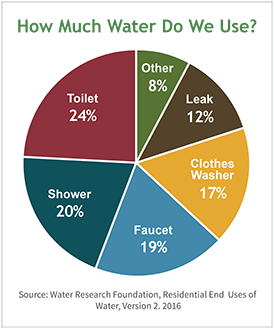
Pie chart of our water use

According to the EPA the average family uses more than 300 gallons of water per day. If you look at the pie chart above (which comes from their website) you can see that we use this water for worthy goals.

Sanitation cannot be overstated. It is what makes life bearable. As such I deem this to be a good ROI for water spending. Though I would stress that we must strive to carry out these use-cases more efficiently.

Efficient use of resources at home is laudable. But we shouldn’t sink into the comforting fantasy that small changes at home will make a big difference for water conservation. The illusion of control that we get from being ‘good people’ is, like most illusions, detrimental.

Even if everybody followed the most stringent conservatism in their domestic water use it wouldn’t begin to make a dent in our ‘water debt’ (To be explained). This is because the biggest water hogs are irrigation and Thermoelectric power.

US Freshwater Withdrawals Chart

As you can see from the above graph almost half of all freshwater withdrawals in 2010 were for Thermoelectric power. Irrigation is the second largest water hog at 32%.

Power and food are essentials. It is a good return on investment to spend water on these things. As with domestic use we must be more efficient here. The efficiencies that we improve in these two areas will have a far greater impact on making sure that we have plenty of fresh water available for the future.

The good news is that we do seem to have had a positive impact on water use.

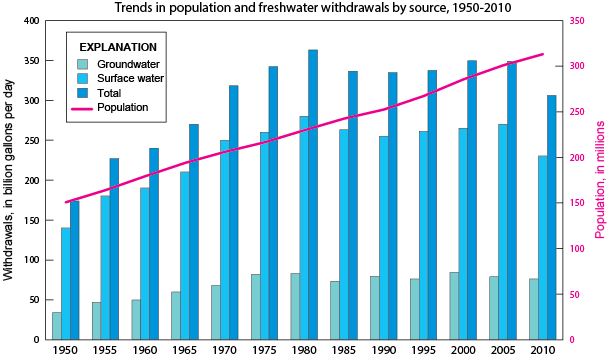
Bar showing showing trends in fresh surface-water use, 1950 to 2010

What the above graph tells us is that there is a relationship between water use and population.

According to this graph water use peaked in 1980. It has since that time remained more or less steady. Though population growth continued along with a greater need for irrigation and industry, total water use has not risen. This seems to suggest that we’ve become more efficient at using water.

While I don’t doubt that greater efficiency in water use has contributed to this pleasant steadiness, I can’t help but think that offshoring a good chunk of our industry may also play a role. (As of the writing of this article I don’t have the exact data but I feel the possibility is worth mentioning.)

Now that you have some idea as to how we use water it’s time to get a bit more in-depth. The next article in this series will delve into the technologies and practices that have allowed us to get more out of water since the 1980’s.


Sources

Diversify your Portfolio

Image result for diversify your portfolio


I suppose I’m a bit stuck on financial terms this week. Probably because they are good analogies for how the world functions. As such you can extrapolate insight into a lot of issues far outside the narrow field of bottom lines.

When people hear ‘Diversify your Portfolio’ they immediately think of Wall Street. Your stocks, bonds, and other securities are not the only portfolio you should diversify.

Another image that may come to mind is the artists portfolio. Sometimes this image manifests as a large envelope, full of prints, sitting in the corner of some studio, littered with evidence of robust endeavor.

But why should our hypothetical hep cat painter limit the contents of his portfolio to paintings?

I thoroughly understand that people must play to their strengths. You don’t want to sacrifice a brilliant painter for a mediocre writer or vice-versa.

However, the painter and writer can both benefit greatly by diversifying how and what they write and paint about. I would argue that these two craftsmen can also benefit immensely by spending a little time making serious efforts in each others fields.

The writer who spends a little time learning to paint won’t risk squandering his potential as a writer. In fact his writing is bound to improve. This is because he isn’t spending all his time painting. He’s painting just a little and with serious intent.

As such he will glean new insights because he is engaging parts of his brain that he normally wouldn’t. He has to think about perspective, shading, background and foreground and learn how to use his hands in a coordinated way to create an intelligible image.

All this dexterity will translate into better writing. The same applies to the painter who tries writing and has to learn about pace, plotting, character building, etc.

So what’s a reasonable amount of time to devote to learning a new skill to help along your current skill? It varies from individual to individual. What works for me is devoting a half hour to hour each morning for a couple of weeks to the new task. This way I learn a new skill without sacrificing current skill-sets.

This journal is built on recognizing the value of diversified skill-sets. This journal is unique in that I double the value for my readers by providing both fiction and nonfiction works.

It struck me last night after I published a poem that some people may find this approach amateurish. (Especially of poems in the context of a news/commentary- reporting flavored journal such as this.)

There certainly does seem to be a consensus that serious people focus on one field and hone their prowess there to near perfection. It’s not an entirely misguided notion. Michael Crichton was master of the techno-thriller, Tom Clancy of military adventure, and Poe of weird story and dark poetry.

Perhaps I differ from these people in that I diversify my approach publicly. I think it is to my benefit that this journal is open-ended, factually rigorous (as possible), musing. Time will tell.

A Week in Sales

Image result for billy mays funny


I am not a salesman. I suppose I could be if I worked at it but I don’t find it very engaging. That’s not to say that Sales is a bad career or that sales people are bad. If you believe in your product or service it can be a fun challenge with a lot of financial rewards. There are a lot of lessons you can learn about yourself and life in general by learning the art of the deal.

After just a week at small direct-marketing company I could probably write a couple of pages on what I learned. A lot of it was simply coming to understand my own reactions and thought process and learning to steer them. Since I think that the latter is important I’ve compiled a short list of ways to do it.

Things I Learned from a Week in Sales

  • It’s easy to agree with objections in the heat of the moment. Don’t.
  • People are much less likely to commit to a product or conversation if you aren’t committed yourself.
  • A lot of your first impressions of peoples attitudes and reactions are wrong.
  • It’s essential to control your inner chatter. Not only is it distracting but it’s usually wrong and can destroy a lot of potential.
  • A lot of people don’t really know what they think much less why. They’re simply reacting to the perceived contours of what you’re saying.
  • Blood sugar levels matter a great deal.
  • Being healthy helps you be good with people.

A lot of this is common sense stuff. I chose to call it learning because there’s a difference between knowledge and experience.

Sure the above observations could come from any kind of interaction. But there is a quality to business and professional interactions that drives the point home more clearly. Probably owing to the fact that you can’t opt out of paying attention to your own reactions, or simply write off miscommunication as being ‘just one of those things.’

All in all I had a good time trying out a new venture. I think that it is especially important for artists, writers, and the like to leave the comforts of Bohemia once in a blue moon. I definitely have a slightly less cynical view of businesses than I did before.

I think understanding the workings of humanity behind corporations and their clients will help me be a more insightful writer.

Is there a career or experience that you think would challenge you and refill your creative wells?

Applying ‘ROI Thinking’ to Environmental Questions

Image result for the atchafalaya basin


This mini-article could have also been called:

‘Why I Apply ROI Thinking to Environmental Questions’

But it looked awkward in the title bar so I opted for what you see there up top.

So, why apply ‘ROI Thinking’ to environmental questions? Well…

Bottom Line: Money represents resources. If we can use ROI to talk about finance which is a roundabout way of talking resources then we can use it to talk about resources.

So, what is ROI?

It’s a business term that means ‘Return on Investment.’

For the Pedantic:

“Return on investment, or ROI, is the most common profitability ratio. There are several ways to determine ROI, but the most frequently used method is to divide net profit by total assets. So if your net profit is $100,000 and your total assets are $300,000, your ROI would be .33 or 33 percent.”

-Return on Investment(ROI) – Entrepreneur https://www.entrepreneur.com/encyclopedia/return-on-investment-roi

This acronym is useful not just for business but pretty much for everything.

What is it that you get out of the work and resources that you put in?

Some may think this a cynical way of looking at things.

But that’s not an accurate interpretation.

ROI has nothing to do with generosity or stinginess it has everything to do with economy.

If you expend all your energy and resources on something then you may not have that energy and those resources for something more vital.

This is why it is vastly important to pay attention to your return on investment.

So what are some resources that we should be careful with.

Let’s start with the general and important ones:

Time, material, and health.

If you spend all your time with one job or friend then you won’t have any for another.

If you eat all your food and don’t have money then you’re gonna be hungry.

If you ignore your health by sleeping only a couple of hours a night to do XYZ then you won’t be doing XYZ for very long.

This is why you need to pay attention to ROI. Which I will now just call Roy.

Roy is easy to understand but difficult to apply.

Like lots of business terms Roy is basically formal wear for simple ideas.

Roy is about getting as much bang for your buck as possible.

The issue that I’m using Roy to evaluate is an environmental one.

I’m trying to figure out better ways of utilizing the vital resource known as water.

By figuring out I mean describing the problems surrounding water by listening to scientists, journalists, and other professionals and then relaying that information through this journal and coming up with my own ideas.

I’m hoping that in so doing I learn a lot and am able to provide an accurate picture of water issues and possible solutions.

I think that a good place to start is Roy. What are we getting out of the water we spend?

Or it’s counter: what are we losing by spending water in the ways we are now?

‘What are we getting out of the water we spend’ and ‘what are we losing by spending water’ will be the subjects of the next two nonfiction essays in this journal.

Thanks for reading and stay tuned.

ROI Today – Are we productive?

Image result for commute

Take cars, for example. It takes 75,000 gallons of water to produce one ton of steel. Since the average car contains about 2,150 pounds of steel, that means over 80,000 gallons of water is needed to produce the finished steel for one car.


An issue that I will be tackling in upcoming weeks is the amount of resources we spend versus what we produce.

I have had a recurring thought on many a commute that the ratio of products and services rendered versus the cost of production is wildly askew.

Many if not most people drive two tons of steel to and from work  a day. You don’t have to even take carbon into consideration to see why this is potentially wasteful from an ROI standpoint.

First there is the metal itself, then there is the time in production and maintenance, then there is the cost of the fuel. Then there are hidden costs such as the 80,000 gallons of water it takes to produce a car.

Understanding how to balance the ratio of resource use and productivity requires abstaining from finger-pointing and taking a long hard look at what’s actually happening.

My goal is to find out how to produce more than we consume.


Here are some links that can provide insights into the scale of consumption for one very vital resource called water.