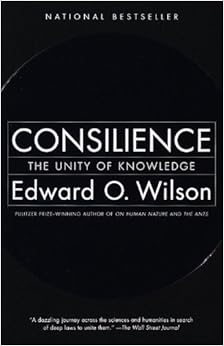
Stray Thoughts Regarding Craftsmanship via – E.O. Wilson’s – Consilience

https://i0.wp.com/ecx.images-amazon.com/images/I/41SNnGFamQL._SY344_BO1%2C204%2C203%2C200_.jpg


Oh, dear it’s already six well…I suppose I’ll just post this introduction to a book review I plan to get on with some time this week.


Before I go into the actual review I’d like to frame it with a few observations.

1998 that is the year of publication. That was the cusp of the new millennium. Little wonder that Wilson saw it fitting or was inspired to write a book like Consiliecne. A book that calls for the sort of cooperation and integrative analysis upon which a fast-pasted, complex, and deeply interconnected future must depend.

I am sixty years younger than the professor. Yet even I witnessed the sort of fundamental technological and societal transition that must have been spectacularly apparent to an attentive person as the 20th century unfolded.

Wilson was born in 1929 and I in 1989. He had firsthand experience of the development of modern airlines, of the civil rights movement, and the rise of computing from primitive room consuming vacuum tube driven monstrosities to the button sized micro-processors of today. I mention this because I have long been eager to relate my fascination and concern with people thrown headlong into the internet age without any real exposure to legacy technology.

I spent my youngest years in Russia. From 1989 to 1998 I was Moscow born and bred. I do not know if my contemporaries state side had as much exposure to older gadgetry as I. But I remember having to use a rotatory phone without irony or affectation. That was my idea of a phone. I also recall women pickling as matter of course rather than as a precious yuppie hobby. Washboards were standard. I don’t think I ever saw a washing machine till after I landed in Atlanta. I remember water based heating systems, archaic toilets, and most of all I remember the sense of having to learn to write well and legibly.

It is the latter point that I wish to stress the most. There is something sacred about writing by hand. About the febrile nature of paper. The care and attention that both author and postman have to give to a letter to deliver through a cold vastness to its intended recipient is a thing of magic. I love typing, I am very much a techie but there is a lot lost in that efficiency.

The geometric patterns of cursive script coupled with the more robust and refined physicality of guiding pen over paper is a transcendant experience. It is one I hold in special esteem because it is the first real form of the development of the formalization of thought, dream, and drive being preserved and thus rendered transmissible. The manner of conceptualizing and abstracting that led to the creation of the modern world owes its existence to writing. This is why I feel it necessary to promote its rawest and most ancient techniques as ones whose preeminence should not be allowed to dwindle.

One of the main themes that seems to run through Consilience is the stifling nature of over-specialization. I feel this to be a valid sentiment. So valid that it’s a fact. I think that over-specialization, professional, and social nearsightedness is due in part to an atrophying of humanistic arts like handwriting. Craftsmanship and artistry seriously executed as discipline provide a fertile ground from which good science and sound philosophy can spring.

This is a sentiment that I think E.O. Wilson would agree with for reasons that should become apparent as I outline and review this timely and worthy work.


The review will be posted by next Friday.

Retro and the Crow

20180117_135110


What’s the point then?

A computer, a technology, should never be a tether. It should be a tool to enhance knowledge, productivity, and pleasure.

To use a tool properly, one must learn to get by, to get about one’s business without it.

That’s why, post-shower, I am making this hand-written entry with my PC turned off.

There is only the pen, the paper, the ticking of the clock, and the sound of a radio coming from the other room.

Here I am, at my task, the task of writing, with more pleasure, ease, and sentience.

There is no song, no YouTube video, no endless podcast, there are no headphones at all. I do not drown passively among other people’s voices. I select what’s relevant from memory.

I do not fear that my thoughts will be lost, that they will suffer in quality because they are a scrawl in afternoon light rather than coordinates on a glowing screen.

I feel no unease at the knowledge that digitally augmented ken, all the world’s libraries, and forums, are one further step away.

I am in fact as free and secure as the crow that just flew overhead.

Because I have made it possible, more likely to see him.

I have but to swivel in my squeaky office chair to boot the machine. Should I fancy to share my insights electronically.

Perhaps soon I will. But not before I visit a long neglected couch to read a hand-held book.

Such is the exercise I choose to assure a firmer grip upon my faculties.

Through this I find my freedom, my mobility expanded, and my electric bill a touch more modest.


20180117_135253

TAP # 11 – Glib, Glam, and Guano (Vlog)


In this installment of TAP (The Audity Podcast), I discuss pitfalls in reasoning that come from the way that information is popularly presented.

Presented in gloriously anachronistic black and white because I am a shameless hep-cat hypocrite!


Example One: http://psychologyofeating.com/mind-over-food/

Example Two: http://reason.com/archives/2002/09/25/i-dont-care-where-my-food-come


Further reading:

Antonio Damasio’s – Descartes’ Error: Emotion, Reason, and the Human Brain

https://www.amazon.com/dp/B00AFY2XVK/ref=dp-kindle-redirect?_encoding=UTF8&btkr=1

Jamie Whyte’s – Crime’s Against Logic

https://www.amazon.com/Crimes-Against-Logic-Politicians-Journalists/dp/0071446435

The Regular Irregular – (Poem with Essay) Jeder Rilke ist schrecklich


Related image
The Regular – Irregular
‘Jeder Rilke ist schrecklich’
Poem with Essay


Hardly are there any hours

Scarcely do they ever stay

Called as if by unseen powers

This strange gift loves to stray

First, it was giddy

Tearing at tinsel

Then it was less greedy

A casual spell

Finally, I learned to see

That unwrapping is entirely unnecessary

Here all my watches blossomed

Every clock was a trade-wind

My steps were more assured

To those who’d say

That’s the mechanical way

Machines with their precision

Are no way to make decision….

Yet, I’ve turned my broken gardens into woods

Our park of long-rusted mistake into understoods

Yes

I am a regular
Irregular

Good-Day

2:16 PM on a Tuesday


Schrecklich

I do recall it. I recall often. Or at least so often as it recalls itself. At times reconstituted from the way that summer rain brings that moisture peculiar to doors left open at twilight.

Rainer Maria Rilke

I’d have never known the name save for a friend. She was a working musician that I’d met at a party half a decade ago.

She had a small room with what I think was a red couch. On one wall there was a picture of Christ with ashen eyes and a crown of thorns. There to watch me sin. On the other a picture of Virginia Woolf to scoff at our lack of gravity. Then some jaunty looking flapper with a black sunhat in hand striking a tom boy’s ‘Jack the Lad.’

It was in that room with the smell of rain that I pulled from her shelf of books a paperback of Rilke’s. At such times that we’d separate ourselves, I’d read. So I read.

It was the introduction rather than the poems that interested me. As far as I recall they tell of a young or perhaps not so young Rilke’s struggles. The point is I at the time imagined Rilke to be about twenty-two years of age like myself.

The struggles seem to have been primarily regarding a lack of productivity. One recounted episode (if my memory serves me well) was about how Rilke would endeavor to sit every day with punctuality to write something. He’d end up doing nothing. Or so was the effect of the tale on my imagination.

The feeling it produced in me was fear. They say that the most fearsome things are unknown. But it was the familiar that struck fear deep within me.

Was my tongue forever to be stilted? Was I merely going to pass my days in such a fashion, caught between worlds, dizzy with the urgency of that which must be said, and fornicating instead? Metaphorically of course.

It did or didn’t help that Whitman was there as contrast.

Yet, I had my gravity. The thing that would pull toward creation, toward a pulse.

Though it has taken some years. I believe that I have begun to manifest the strange momentum of a chance discovery.

Entsagung

This is the meaning in whole, or part, of the regular irregular.

Thank you for reading.

The Watering Hole (Vlog)


I’m coming at this from a ‘psychological’ angle. This differs from most people’s usual take on our tendency to not look beyond grocery store shelves because I’m not promoting or contesting ‘organic’ claims. This is just a bit of informal speculation on unseen effects of our ‘abstracted lifestyle.’

– Abstracted lifestyle as I use it here is just a reference to the depth and intricacy of our division of labor. We do not take actions or very often come in contact with those that take actions to ensure health and survival on a ‘primordial level’ (food, water, shelter, heat) and thus are ‘abstracted.’ i.e. Accounting and Computer Programming are abstract professions.  


I do not support or deny any of the claims in the following links. They’re presented to help you form your own opinions.

‘Neutral’ (*sic) Info  – https://www.usda.gov/media/blog/2016/05/25/know-where-your-food-comes-usda-foods

‘Pro Organic’ – https://www.cheatsheet.com/health-fitness/reasons-why-you-should-eat-organic-foods.html/?a=viewall

‘Critical of Organic’ – http://reason.com/archives/2002/09/25/i-dont-care-where-my-food-come#comment

*sic is here used in a somewhat unconventional way as a reminder that there is no neutral party of information since it’s all framed by human beings. USDA is by no means impartial or neutral whatever its attempts may be. Not due to any shortcoming on the USDA’s part necessarily but simply the nature of organizations and people. That being said I believe the information contained in the link is about as ‘impartial’ and rigorous as it probably gets.


Here’s more food related reading: 

Is Twenty-Seven the Perfect Time to Start a Band?

hqdefault


The popular conception is a hard thing to qualify. It is difficult to define a common view because there are so many common views. Yet it can be done. At least insofar as setting the stage for social, psychological, historical, and philosophical analysis.

There do seem to be pervasive opinions that though rarely vocalized may as well be set in stone.

For instance, everyone always expects artists and musicians to be young. At least no older than thirty. This is strange.

It might be because most bands that society is currently familiar with made their mark in their twenties.

There may be some biological reasons for youths blessing of artistic endeavors.

Neurology and the endocrine system come to mind. Then there are the social and psychological variables.

First there is the naivete that’s fertile ground for creative exploration, then there is abundant energy to till that ground, and finally, there is a drive to define and prove oneself. Society also fosters and encourages young creators* whereas there is a greater onus on the mature to be ‘responsible’ and ‘settled in.’

All these factors seem to wane as people age into their thirties. So is it meant to be? Should everyone north of thirty settle into the proverbial accountant’s office and repair their gutters on the weekends?

No.

First, there are many examples of artists who didn’t ‘make it’ until ‘later’ in life. Andreas Bocelli and Leonard Cohen to name a couple.

Second, there are many examples of artists who continued creating masterpieces throughout their lives. Bach springs to mind. As do Johannes Brahms, Richard Wagner, and Stevie Wonder.

Third, if one decides to view life as having many stages, then each stage of life has its own music its own landscapes to offer.

To begin the analysis of creative stages of life let’s examine the art of the young.

The case can be made that the young are too histrionic to produce anything of lasting value. As evidence, one can cite the similarity of subject matter and delivery of bands in the last century.

First, there is the sex, drugs, and joyously cacophonous ROCK starting somewhere around the time of ‘The Doors’ and lasting well through the eighties hair-metal scene. Libidinous excess and boundary flaunting tests of one’s limits through psychedelics and alcohol aren’t the only tritely recurring sins of the young.

There is also the angst and neurotic introspection of Grunge, Alternative, and Progressive genres that cropped up in the late eighties and still hold sway into the era of whistling ironic ukulele hipsterdom. Are maudlin sentiment and bitter emotion really the best subjects to set to music? The young musicians of the last three decades seem to think so.

Given its subject matter and focus, the art of the young has unsurprisingly taken a morbid turn. The 27 Club is ‘a notional roll of remembrance’ that pays homage to the fact that many of the 20th centuries musical luminaries died young. Numbers can be mystic things and the fact that Jim Morrisson, Jimi Hendrix, Kurt Cobain, and Amy Winehouse all died at 27 lends an air of tragic magic to that arbitrary figure. Hence the ‘colloquialization’ of ‘27 Club.’

Death has a certain finality that often lends weight and perceived substance to the art of those who passed. ‘The good die young.’

The audience ‘knew’ these folks as an explosion, as a passionate flame that burned too bright and quick, and suddenly there is the mystery of eternal silence. What more would they have made would they have said? What secret pain, what uniquely anguished insight not accessible to average joe, did these brilliant people harbor? What was it that made people who wrote such tuneful and evocative things so self-destructive?

It would be wrong to characterize these artists as immature. It is a silly business indeed to hover over history like a daft-shrink-bog-wraith psychoanalyzing the minutiae of the lives of its actors. Yet there does seem to be an air of self-fulfilling prophecy to the art of the young.

The deification of such art, the raising of it to some sort of deep expression of the human condition, while at times valid, can also be foolish and dangerous. It is the former because foolish and dangerous things are indeed a part of the human condition. It is the latter because despite the melodic and lyrical finesse of such works they were tainted by hormones and substance abuse. A tainting that leads to a sort of ‘Opera Buffa‘ where those who gained much admiration and success, freshly minted aristocrats in a sense, weren’t sated by such things and chose to become a tragedy for a convoluted sense of authenticity or psychic chaos magnified by chemicals and overcharged emotions.

The creative stages seem to fit pretty neatly into the categories of the prodigy, the rockstar, the craftsman, and the master.

  • The Rockstar has already been discussed, the rockstar is the art of the young, it is somebody that might very well be talented or not so talented but they have something to say and by God, they will say it.
  • The preceding ‘Prodigy’ is a precocious child with uncanny technical skills and well-directed enthusiasm.
  • The Craftsman is a stage that comes after prodigy and rockstar and is a person dedicated to the disciplined acquisition of skills and diligent creative output who has a broader repertoire of life experience to draw from and can do so effectively and judiciously.
  • The Master is the craftsman after many years of practice. One can look to Bach responding to the challenge of Friderich the II, improvising a three and then six-part fugue on a theme presented by that monarch.

The space of this essay will only allow the exploration of two out of four of the stages of creative life. So in light of all the information considered which would be best to unpack?

Since the ‘rockstar’ has been addressed it seems fitting to move next in line to ‘the craftsman.’

As the world approaches the cusp of a new decade, is it not fitting to promote a new sort of ‘27 Club’? Why not popularly consider 27 to mark the beginning of careers rather than looking with perverse expectation towards the demise of heroically dysfunctional musicians?

Twenty-seven may, in fact, be the perfect time to start a band. One still has abundant energy which can be used in conjunction with greater mastery over one’s emotions to select which insights and life experiences to magnify through art. Further, it is a time when hormonal needs and spastic bursts of energy will be less of a barrier to serious practice. Your bandmates are more likely to show up on time.

Why disparage the rockstar and highlight the craftsman?

The prodigy, the rockstar, and the master need no encouragement. They will do what they do as a matter of compulsion. The craftsman is the most suspicious of compulsion. As a person moving further into adulthood and feeling the weight of experience, the craftsman becomes wary and guarded, sensing a profounder need to be ‘serious and secure.’
Sometimes this need to be ‘serious and secure,’ to be a steady sort, manifests itself as studied avoidance of creative endeavors. Partly because one is keenly determined to avoid wasting time which has greater weight than ever before. Partly because one wants to avoid seeming gauche.

The truth is that music and art are never a waste of time. They sharpen all the skills and faculties necessary to succeed in work and relationships. Communication and synthesis are two skills most readily and deeply refined through creative endeavor. Atop this boon, there is another in that the magnification of life through art makes you very appreciative of even the most mundane and prosaic aspects of living.

There is nothing gauche about loving life or succeeding in relationships and the workplace.

These stages are of course guides rather than rules. Some may find themselves at a place of overlapping stages. Whatever stage you’re at…what are you waiting for?

Go forth and create.

*There will soon be another essay on the unique challenges of creative youths in the present college and structure obsessed society that purports itself to be a bastion of free-thinking creativity.

Related Links and Reading

https://www.digitalmusicnews.com/2015/08/03/18-musicians-who-made-it-later-in-life/

https://www.youtube.com/watch?v=4OtouQnfnZU

Keeping the Flame

Bach and ‘Mental Hygiene’ (Vlog)


I made a vlog about how you can use Bach to tidy up your brain and prepare you for practice. There’s also some brief discussion of the value of classical imagery versus ‘meme-ish’ caricatures. Don’t get me wrong I do love my memes. But there’s a world of difference between meat and potatoes vs. cheesecake and Scotch.

This vlog is very similar message-wise to this video: https://www.youtube.com/watch?v=2ogZ4vBgHd0

And this essay: https://fractaljournal.com/2018/01/02/classics-and-the-true-way/

Counterpoint: https://www.youtube.com/watch?v=4O6lc_ym12U

Keys and moods: https://www.artofcomposing.com/key-signatures-make-the-music

Subscribe, comment, and like. Or don’t. Thanks for stopping by.

Sleep ‘Hack’

Image result for antique alarm clock


I stumbled on this very common sense trick this morning.

I have a variable schedule that sometimes requires me to be at work at three am.

The importance of sleep cannot be overstated. A brief web query will confirm this.

Knowing well the effects of inadequate sleep and how they can sneak up on you, when you start to view a ‘sub-optimal’ (to say the least) state as normal, I feel it important enough to share my little trick.

It starts with the well known and obvious habit of laying out your clothes for the coming day by your bedside.

Most people are probably already aware of the benefit of preparing a minimalist protein-rich breakfast that you can wolf down with efficiency. (Or skipping it altogether, if you are accustomed to intermittent fasting and know how and if it will affect your performance at work and throughout the day.)

Even if you adhere to such disciplines consistently (and in so doing gain a tad more time to snooze) you might still get that morning fog that makes you groan.

I really felt it this morning and thought hey, yea….

‘I generally give myself an hour to prepare in the morning.

But today I’m not going to be reading the news and having my coffee I’m going to get some extra shuteye without drifting off into that oblivion that imperils your livelihood.’

So I got out of bed, put in my contacts, put on my work clothes, put the coffee pot on, and hopped back into bed setting my alarms (I have multiple alarms) for another hour of sleep. Leaving me just enough time to gulp down my caffeine boost and motor off to work.

It worked. I awoke feeling far more refreshed than usual and didn’t stay in bed too long. I gulped down some kefir for the protein essential for promoting and preserving wakefulness and went off to perform my duties with a clarity of mind that lasted all throughout the day.

Obviously, everyone is different and at different points in their life so adjust this advice according to your needs. I hope you found this helpful. Thanks for reading.

TAP # 10 – Genussiness – Violin Yoga and Death


Don’t you dare skip my soulful karaoke session!
Did you see that smug look! I thought I was being scholarly. There’s no such word as Genossischkheit as per my web query. Nonetheless I take poetic license and dub this Genussiness which is a word for enjoyment without abandon.


Subjects Discussed 

1) Music and how neat it is that instruments are much more readily available due to financing options like rent to own.

2) ‘Violin Yoga’ or using an instrument to center yourself rather than some esoteric practice or as a complement to your esoteric practice.

3) How learning different instruments are good for getting a better feel for music quicker. IMO.
4) Genussiness – the best way to approach life in the context of the knowledge of death. Which in my opinion is using things like art and music to help you live life to the fullest without the opera buffa of being a ‘tragic artist.’ Enjoyment without abandon. The union of the bridge builder and the painter.
5) The environment through the lens of Michael Crichton’s book State of Fear and E.O. Wilson’s book Consilience.
6) How despite having an art friendly culture it’s often difficult to find work and get along with other artists.
7) An attempt to point out how good things are despite the serious challenges I brought up.

Links ‘n Such
Made to love Magic (Nick Drake) – https://www.youtube.com/watch?v=5D1YS…
Consilience (Book by E.O. Wilson) – https://www.amazon.com/Consilience-Kn…
The Yellowstone Environmental Quagmire – http://www.nytimes.com/1994/06/30/opi…
Violin Rent to Own! – https://www.musicarts.com/

Classics and the True Way

Schmoll_Goethe_Va

It was either Goethe’s Werther or Wilhelm, that provided me with a certain sense of balance. I’d never really read the books except as exercises in seeing how much I could glean with my sparse knowledge of German.

It was a secondhand account, either in a book or in some online posting that I gained some familiarity with the plot and style.

I’d taken an interest in Goethe after stumbling across Blixa Bargeld while listening to internet radio a number of years ago. I’d already been steeped in Nietzsche, as every edgy teenager should be, and thought it would be fitting to add another dead German to my Trane of pretensions.

Blixa’s rendition of Wanderers Nachtlied (Ein Gleiches) is very good but the poem is even better. It’s sparse and stuffed with ponderous depth. Something I’ve come to expect from all things German.

Bach’s genius I think lies in taking something very simple and making vast frescoes and stuccoes out of it in the uncanniest of ways. I’d already been pretending to be fond of Bach for years. So all the pieces of how I thought an antiquarian revivalist should behave had fallen into place.

When I say pretension I do not mean it a negative way. Although there was some ulterior motive in that I was struggling to set myself apart. This instinct for differentiation common when crossing the bridge from boy to man was well served by my choice of subject.

Classicism is life. Classicism is the lodestar that guides one to the True Course. So when I say pretension is not negative I mean that there is absolutely a necessity for everyone to assume an affectation. Today’s ‘authenticity’ with its blue jeans and four chord ballads is itself an affectation. One can choose to don it, or cast it aside in favor of another, but either way, the choice must be made, and it had better be a good one.

Certainly, those who prefer the bold-mans affectation will feel a bit stifled by the tried and true sure bet of classicism but I think this would be a misreading. Just like one can’t really play jazz without being well versed in the rules that need to be broken one can’t really be an adventurous man of action without knowing from what it is he is departing.

Alan Watts described classical music as being the purest expression of music for music’s sake.* I don’t think that it would be a mistake to say that he found classical music to be tres Zen. I happily agree with his assessment.

Wu Wei is the True Way and Classicism is the best of affectations because it is the ultimate falling into place. The sense of solidity that one gains from something obviously good, from something that is Der Ding An Sich, is not just an accident of custom. It is not something that we relish and cherish simply because it is old.

No. It is old and remembered because it retained the most salient features of the human experience in the most efficient way possible. This is the reason why I call it the lodestar to the true course because those who don the affectation of Classicism will be able to forge new paths. Paths that last. And even if one does not forge any new path one will be fortified by an acquaintance with transcendent beauty that will make even the dreariest of circumstance bearable.

Today’s obsession with novelty and authenticity seems to produce nothing but remakes. Those who most proudly proclaim progress and define themselves as acolytes of the future are stuck in the past feeding on bread that’s decades stale.

Why is it that the seventies, eighties, and nineties produced so much that was so new and so full of depth? Because those generations were still steeped in classicism. They had good models from which to diverge. Today we merely have the echoes, of the ghosts, of what they built to rely on.

There is much that I like about today and there are still amazing artists, philosophers, and scientists and I don’t think it needful for everyone to mutter over Virgil to make valid and beautiful contributions. However, a bit of Virgil would certainly help.

Just the hint of what Goethe was getting across has helped me to gain a surer footing and be productive as a writer and amateur musician. Not only has it helped me in these regards but it has helped to cement my purpose and sense of what it is to not only be a man but a human being.

Some web searching being in order I found the thing that had been transmitted to me through the hint of Goethe: Entsagung. A word which roughly translates to renunciation. Renunciation of what exactly. I think a renunciation of swaying to and fro. I think that perhaps a more fitting term would be resignation. Resignation to what? To Wu Wei, to something like the Tao, or what have you, if you will.

So the thing in itself, Der Ding an Sich, Art pour le art, etc. is simply the purest expression of what is to be human and is grasped when you have the balance you get, from Entsagung, a balance that allows you to see loading trucks as fuel for writing poetry.

The classics in whatever form, whatever genre, will never be forgotten. For it is through their cardinal points that we find Wu Wei that truest paths…

A path lined with columns, arches, and flowering gardens of the most sublime craftsmanship hinting and singing of the most profound depths that lie in even the commonest of things.

* Alan Watts wrote several books and delivered many lectures so the specifics of the attribution may be a tad off. I’ll attempt to either rectify or supplement this information when I get the time.

Image result for ancient compass