Pineapple Time – Idea Medley – Why Write and More (Vlog)


Just another mish-mash of ideas in vlog form that I’ll just refer to as Idea Medley. Today we’ll be talking about pineapples, gut and performance, and reasons for writing, among other things.


Links

fractaljournal.com is my main site where you’ll find stories, essays, webcomics, and more

Here is Stefan Mischook’s YouTube channel and the course I’m taking 

youtube.com/channel/UCyUBW72KU30dfAYWLVNZO8Q

killersites.com

The Udemy Bootcamp 

udemy.com/complete-python-bootcamp/learn/v4


I’m now on DTube: https://d.tube/#!/c/mellow.mission

How Great It Feels – Musings on Creativity

Image result for craftsmanship


Don’t forget how great it feels to create. To have a finished product, or to be working towards a finished product.

People are often miserable. There are a billion things to be miserable about, many with good cause. But, there is balm, there is hope.

One way to allay misery is to create. This option is often forgotten through disuse.

Just like the person who doesn’t know how bad off they really were, how abnormal their state was, until they start exercising, folks who don’t create regularly forget that it is an option.

They forget that it is profoundly satisfying to assemble memories and ideas into coherency, to hone the turn of a wrist, or the flick of a brush, to near perfection.

Most of all, it seems that they forget that is possible. That it is an option open to everyone and not just folks inhabiting rarified heights fortified by talent and divine favor. How would you even be able to enjoy such things if you didn’t contain the seed of their genesis?

When one ceases that most natural of human activities, or allows it to dwindle to occasional outbursts, let’s that mighty river become a trickle… Satisfaction becomes damnably difficult. Everything seems spartan, prosaic, and utilitarian. And even the spartan, prosaic, and utilitarian things, don’t hold the stoic magic that they should.

Computer screens seem crisper, the neatly arranged icons carry intent, the white broken stripes of a roadway are very nearly a poem, the feel of a key beneath the forefinger entices toward a greater dance. Then there is the electric hum. You are turned on. Why would you ever want to be turned off?


Image Credit – https://www.westleyrichards.com/new-guns/craftsmanship/

TAP # 13 – The Art of Consistent Art (Vlog)


Really shoulda been called the art of consistent uploads but eh…
Here is the TL;DW (too long; didn’t watch) version of this vlog:

The main message is that consistent posting helps you develop your artistic vision, relevant skill-sets, and confidence. Consistent posting can, however, be difficult due to psychological hurdles. I whittle these down to five variations on the themes of romantic notions and perfectionism.

Here they are:

5 Barriers to Consistent Posting

1) ‘High Volume Leads to Low Quality’ – This is a form of perfectionism. The thought goes ‘If I post for the sake of discipline, for the sake of posting, then those posts aren’t going to be good, quality over quantity.’ Well, I think the case can be made that the biggest barrier to quality is lack of quantity (lack of practice). The feedback and stamina you receive from putting your best possible foot forward is exactly the sort of journey that will take you on the road to higher quality creations. Wallowing in notions of making something good, better than ‘those wankers polluting the internet’ isn’t going to get you very far.

2) ‘Effort Fallacy’ I don’t know if this is an official logical fallacy but I see it so often. What I mean by this is that when things feel too easy they don’t feel worthwhile or authentic. It’s really easy to post, to start a blog, therefore at times people feel cheap and illegitimate. They long for validation. Being published by Random House, or being on a music label are perhaps the only things that will make them feel like they’re contributing something of value (Don’t get me started on college…).

This is because the person with this sort of psychological state is hungry for litmus tests. It’s not necessarily a bad thing since going through the process of gaining the approval of professionals is a valuable obstacle course. However, it is still a fallacy because that obstacle course does not necessarily ensure quality.

Quality can be assured by objective tests such as economy of language, readability, descriptive depth, or clever implementation of the circle of fifths. You can do that on your own. It’s especially important to do that on your own because eventually you will have to, and you will gain the approval of professionals faster, if you gain real-world exposure by putting yourself through the paces, of putting your stuff out there.

3) ‘There are a zillion voices and artists, I won’t get heard.’ Well, sure over-saturation is a thing. The good news is that it has always been a thing and many people have still been able to overcome it. The problem is certainly compounded today because technology has allowed yet more voices to enter the arena at an ever-increasing rate. Yet, from everything that I’ve observed, if you put something out there and it’s good, there will be people who find it, enjoy it, critique it, etc. Sometimes even if it’s not so good. I find that I am able to discover new content creators frequently and keep up with at least twenty or so on a weekly basis.

4) ‘Privacy and Security’ This is perhaps the most valid concern on this list. People don’t feel comfortable becoming a ‘public figure.’ Fortunately, there are pen names. It’s important to not let FUD hold back your creative development. Something that you can only gain through practice and feedback.

5) ‘I haven’t the time.’ In this world of washing machines, automobiles, and 4g even a parent working full time will eventually find the odd hour (I think it’s much more than the odd hour, given the fact that people find time for the Super Bowl etc.) Whatever your window is, use it. Building your creative skill-sets will benefit your life in a host of ways.

Hope this has been helpful, thanks for watching, listening, or reading.

Cheers.

For essays, stories, webcomics, and more visit:

http://www.fractaljournal.com

TAP # 12 – Win like a Winston (Vlog)


I talk a bit about the need for replacing your ‘dopamine hit’ activities with more productive pursuits. So instead of a beer learn a guitar lick etc. Though of course you’ll want to have that beer once in a while. Striking the right balance is what I’m aiming for.


Links n’ Such

  • Towards that end it’s good to have different creative and productivity outlets. Something that was called to mind by a post on Winston Churchill on this blog:

The Churchill School of Adulthood Conclusion: Thought + Action = An Awesome Adulthood

(I don’t think this is the exact article I read. I actually can’t find it and don’t have the time. But this has the same spirit and I hope you enjoy.)

  • Here is a similar website in terms of good advice:

Home

The vibes from those sites are what got me goin’ on this little riff.


Addendum: “Sales is a transfer of energy.” That’s a thing I heard a lot a couple of gigs ago. “Sales is also a transfer of debt.” I thought to myself in my illfitting suit. Though some might think this vlog just another rah rah motivational they may be right. But so was my old boss. There is value in a transfer of energy.

IMO, This little vlog  is a much more useful transfer than convincing you to switch your cable provider. I also made sure to intersperse it with some pretty sound philosophies and facts.

Thanks for stopping by.

Is Twenty-Seven the Perfect Time to Start a Band?

hqdefault


The popular conception is a hard thing to qualify. It is difficult to define a common view because there are so many common views. Yet it can be done. At least insofar as setting the stage for social, psychological, historical, and philosophical analysis.

There do seem to be pervasive opinions that though rarely vocalized may as well be set in stone.

For instance, everyone always expects artists and musicians to be young. At least no older than thirty. This is strange.

It might be because most bands that society is currently familiar with made their mark in their twenties.

There may be some biological reasons for youths blessing of artistic endeavors.

Neurology and the endocrine system come to mind. Then there are the social and psychological variables.

First there is the naivete that’s fertile ground for creative exploration, then there is abundant energy to till that ground, and finally, there is a drive to define and prove oneself. Society also fosters and encourages young creators* whereas there is a greater onus on the mature to be ‘responsible’ and ‘settled in.’

All these factors seem to wane as people age into their thirties. So is it meant to be? Should everyone north of thirty settle into the proverbial accountant’s office and repair their gutters on the weekends?

No.

First, there are many examples of artists who didn’t ‘make it’ until ‘later’ in life. Andreas Bocelli and Leonard Cohen to name a couple.

Second, there are many examples of artists who continued creating masterpieces throughout their lives. Bach springs to mind. As do Johannes Brahms, Richard Wagner, and Stevie Wonder.

Third, if one decides to view life as having many stages, then each stage of life has its own music its own landscapes to offer.

To begin the analysis of creative stages of life let’s examine the art of the young.

The case can be made that the young are too histrionic to produce anything of lasting value. As evidence, one can cite the similarity of subject matter and delivery of bands in the last century.

First, there is the sex, drugs, and joyously cacophonous ROCK starting somewhere around the time of ‘The Doors’ and lasting well through the eighties hair-metal scene. Libidinous excess and boundary flaunting tests of one’s limits through psychedelics and alcohol aren’t the only tritely recurring sins of the young.

There is also the angst and neurotic introspection of Grunge, Alternative, and Progressive genres that cropped up in the late eighties and still hold sway into the era of whistling ironic ukulele hipsterdom. Are maudlin sentiment and bitter emotion really the best subjects to set to music? The young musicians of the last three decades seem to think so.

Given its subject matter and focus, the art of the young has unsurprisingly taken a morbid turn. The 27 Club is ‘a notional roll of remembrance’ that pays homage to the fact that many of the 20th centuries musical luminaries died young. Numbers can be mystic things and the fact that Jim Morrisson, Jimi Hendrix, Kurt Cobain, and Amy Winehouse all died at 27 lends an air of tragic magic to that arbitrary figure. Hence the ‘colloquialization’ of ‘27 Club.’

Death has a certain finality that often lends weight and perceived substance to the art of those who passed. ‘The good die young.’

The audience ‘knew’ these folks as an explosion, as a passionate flame that burned too bright and quick, and suddenly there is the mystery of eternal silence. What more would they have made would they have said? What secret pain, what uniquely anguished insight not accessible to average joe, did these brilliant people harbor? What was it that made people who wrote such tuneful and evocative things so self-destructive?

It would be wrong to characterize these artists as immature. It is a silly business indeed to hover over history like a daft-shrink-bog-wraith psychoanalyzing the minutiae of the lives of its actors. Yet there does seem to be an air of self-fulfilling prophecy to the art of the young.

The deification of such art, the raising of it to some sort of deep expression of the human condition, while at times valid, can also be foolish and dangerous. It is the former because foolish and dangerous things are indeed a part of the human condition. It is the latter because despite the melodic and lyrical finesse of such works they were tainted by hormones and substance abuse. A tainting that leads to a sort of ‘Opera Buffa‘ where those who gained much admiration and success, freshly minted aristocrats in a sense, weren’t sated by such things and chose to become a tragedy for a convoluted sense of authenticity or psychic chaos magnified by chemicals and overcharged emotions.

The creative stages seem to fit pretty neatly into the categories of the prodigy, the rockstar, the craftsman, and the master.

  • The Rockstar has already been discussed, the rockstar is the art of the young, it is somebody that might very well be talented or not so talented but they have something to say and by God, they will say it.
  • The preceding ‘Prodigy’ is a precocious child with uncanny technical skills and well-directed enthusiasm.
  • The Craftsman is a stage that comes after prodigy and rockstar and is a person dedicated to the disciplined acquisition of skills and diligent creative output who has a broader repertoire of life experience to draw from and can do so effectively and judiciously.
  • The Master is the craftsman after many years of practice. One can look to Bach responding to the challenge of Friderich the II, improvising a three and then six-part fugue on a theme presented by that monarch.

The space of this essay will only allow the exploration of two out of four of the stages of creative life. So in light of all the information considered which would be best to unpack?

Since the ‘rockstar’ has been addressed it seems fitting to move next in line to ‘the craftsman.’

As the world approaches the cusp of a new decade, is it not fitting to promote a new sort of ‘27 Club’? Why not popularly consider 27 to mark the beginning of careers rather than looking with perverse expectation towards the demise of heroically dysfunctional musicians?

Twenty-seven may, in fact, be the perfect time to start a band. One still has abundant energy which can be used in conjunction with greater mastery over one’s emotions to select which insights and life experiences to magnify through art. Further, it is a time when hormonal needs and spastic bursts of energy will be less of a barrier to serious practice. Your bandmates are more likely to show up on time.

Why disparage the rockstar and highlight the craftsman?

The prodigy, the rockstar, and the master need no encouragement. They will do what they do as a matter of compulsion. The craftsman is the most suspicious of compulsion. As a person moving further into adulthood and feeling the weight of experience, the craftsman becomes wary and guarded, sensing a profounder need to be ‘serious and secure.’
Sometimes this need to be ‘serious and secure,’ to be a steady sort, manifests itself as studied avoidance of creative endeavors. Partly because one is keenly determined to avoid wasting time which has greater weight than ever before. Partly because one wants to avoid seeming gauche.

The truth is that music and art are never a waste of time. They sharpen all the skills and faculties necessary to succeed in work and relationships. Communication and synthesis are two skills most readily and deeply refined through creative endeavor. Atop this boon, there is another in that the magnification of life through art makes you very appreciative of even the most mundane and prosaic aspects of living.

There is nothing gauche about loving life or succeeding in relationships and the workplace.

These stages are of course guides rather than rules. Some may find themselves at a place of overlapping stages. Whatever stage you’re at…what are you waiting for?

Go forth and create.

*There will soon be another essay on the unique challenges of creative youths in the present college and structure obsessed society that purports itself to be a bastion of free-thinking creativity.

Related Links and Reading

https://www.digitalmusicnews.com/2015/08/03/18-musicians-who-made-it-later-in-life/

https://www.youtube.com/watch?v=4OtouQnfnZU

Keeping the Flame

Waiting for Jill


O my. I fear that I am becoming the master of hackneyed points. So be it.

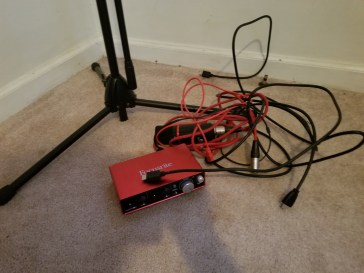
The little hobbyist recording kit I’d bought about a year ago still has a short in it. I’m sure the company would have honored the warranty if I’d sent it in, but I’m terribly bothered by even the mildest of bureaucratic tasks and haven’t fetched the information necessary to do so.


20180101_170915.jpg
Affordable and works well when you treat it right. 


That’s why I made the video. Well, sort of. It’s part of the reason. I also just enjoy sharing my thought processes and certain “authentic” spur of the moment little events.

I really fancied the silly little vocal melody and lyrics that I’d come up with and didn’t want to forget the cadence, pitch, and rhythm. So I thought I’d record it. Given how my phone is currently my mic and camera that’s what I used.

My dog being the nosy pest that he is decided to burst in, which added to that sort of spontaneity vibe and I thought, ‘Hmm… why not just post this.’ Maybe it’ll give someone a few moments of amusement.

Most of all though, it allows me to do my favorite thing which is pontificate about creativity and process.

I think most musicians and songwriters are too busy with the act of creating and recording to bother to share their thoughts on the matter too often. How fortunate that I’m primarily a writer and philosophy nerd. This means that I analyze the ever-loving hell out of absolutely everything for what I hope is your enjoyment and edification.

I think the fantastic thing about things like the story of Jack and Jill is that they are these little archetypes. Not so much of a particular concept like ‘the maiden’ or the ‘wise man’ but more about the vibe of a thing. They transmit a certain plasticity which makes them wonderfully malleable items for the formation of lyric and poem.

All I had in my head was the name Jill for whatever reason and then obviously Jack and the blasted hill entered in by association. Generally, such nursery rhyme things evoke memories of blissful childhood, best represented by ‘the moment of sunshine,’ and so I had myself a theme and little lyrical bits I could assemble into a coherency.

Obviously, the familiarity of the story also means that it’s likely primed for a warm reception in the mind of the audience and artist alike.

Yes, there may be some contrarian hipster sorts who’d balk at something so mainstream. However, perhaps they can fall under that ‘ironic’ spell of something so bad (by virtue of hacky premise) that it’s good.

Although, now that I think about it…maybe Jill wasn’t on my mind at all. I think that I’d wanted to go to my favorite meadow in the local wood like the dirty hippy I am. Out there is where I like to soak in the sun, as I read things like Emerson, and mock myself for the fact that I actually unironically own a hacky sack. In these moments where I’m alone in solitude, I realize, that although it is a happy solitude, I am waiting for something, longing for something.

There’s a lot to long for and wait for in a universe of infinite possibilities. But one of those things which is most tangible as a representation of them all is the lover. So perhaps it was the archetype of the maiden that spurred me on all along.

I felt especially happy that the name Jill entered into my head as a result of that ‘x variable’ that was necessary to get across this crunchy vibe. Its puerile simplicity is a wonderful foil, or background, to a concept that could be weighed down by a lot of cosmic portents which would render it unfit for my current purposes. I wish to convey happy expectation not...SEHNSUCHT

So, I hope that you’ve found this to be as fun to read and watch as I had in writing and recording it.

Thanks for stopping by and have a great time wherever time finds you.


Birdie’s Window and Did Crichton Float?


I do a song, and I’m going to be doing book reviews, so I thought I’d start with Sphere.

This Michael Crichton classic is one of my favorite reads and I only just now noticed how it may be related to a float tank experience he may have had. Feedback is always welcome and thanks for stopping by.

– Addendum: “After trying out several models, Perry settled on a tank that used 10-inch-deep water saturated with Epsom salts. He and his wife Lee opened a float center in Beverly Hills in 1979, renting out their five tanks largely to entertainment industry types. Michael Crichton came in to float when he had writer’s block. Eventually, Crichton bought a tank of his own.”

http://www.slate.com/articles/life/anything_once/2013/05/sensory_deprivation_flotation_tanks_i_floated_naked_in_a_pitch_black_tank.html

Nerdy Delights for Crichton Fans (everyone else too! good stuff here.) 

http://primate.uchicago.edu/2008Crichton.pdf