A Defense of Journalism

There is some salty language briefly. It is included because it is how some people talk. Skip it if you’re offended. There’s lots of content here.

Image result
Edward R. Murrow

Don’t Be Defensive

I’m always going to remember sitting in my techie friends small office bedroom, on the big medicine ball, serving as the only available guest chair. There was no bed. Simply a hammock and two high powered PCs. I’m always going to remember it because it’s damned quirky.

I’ve been meaning to learn Java since I found out about it around 2007. I didn’t have the knack for it, but I’m stubborn, so I still have that goal on the back-burner to this very day, a full decade later.

I’ve made some modest progress, over the last couple of years towards that end. I’m a writer so I’m a narrative guy (Learn through/Thrive on: stories), so careful reading, and lots of web queries on background info were my go to.

Slowly but surely, through lots of notes on the free tutorial provided by HWS, and Niemeyer & Leuck’s: Learning Java; I’ve been able to absorb enough basic principles to where I don’t feel completely lost, as I feed bad code into NetBeans.

It was my geeky reading habits, and the opportunity to exchange off-color jokes that found me in the strange little blue room.

We were having a discussion on the strengths and weaknesses of various programming languages.

There was a stack of programming manuals on the desk. I asked about C++ and the book. And then somehow, the conversation turned to the creator of the language, and author of that particular volume: Bjarne Stroustrup.

O he’s a little bitch.”

I thought this odd.

“That book…it’s …he’s just…”

I really didn’t have a comment. But not for any nobler reason than sheer ignorance.

“He’s just such a defensive little bitch.”

“How so?”

“It’s just he goes on and on…just complaining…he’s almost whiny…like I can’t stand it. You shouldn’t have to explain why something is good, he just comes off as super insecure, it’s a pain in the ass to read.”

“Well,” I said as my writer’s sympathy kicked into high gear, “critics are assholes, often dishonest assholes, dishonest partisan assholes, and I bet a buncha C Nazis were giving him hell, I don’t think addressing criticisms and misunderstandings is defensive.”

“Eh…yeah…but the way he does it. It’s just…cringy. You should just make something so good that you don’t have to explain why it’s good.”

“Yeah, but what if ya did, and a buncha schmendricks picked it apart, and just painted a totally inaccurate picture of it…”

“Yeah, I get that, but it’s just not as good of a book as it could have been if he wasn’t so fuckin’ whiny. And like…you should make something so good…that no one can say shit about it. Period.”

This conversation went on for a while, it is one that I’ve committed to memory, as it’s indicative of a certain attitude that needs addressing. It is an attitude that I find to be common among techies, medical professionals, and business-people. It’s a certain overdeveloped minimalism that breeds error, haughtiness, and hypocrisy.

Actions Speak Louder Than Words’

My friend isn’t stupid. The idea that you can create something that’s unassailably good, was just a result of the hyperbolic way we talk. If such a thing as perfection existed, I think that human beings would still find ways to fault it.

What I found staggering about my conversation is that, there was that element of ‘you shouldn’t have to explain things.’

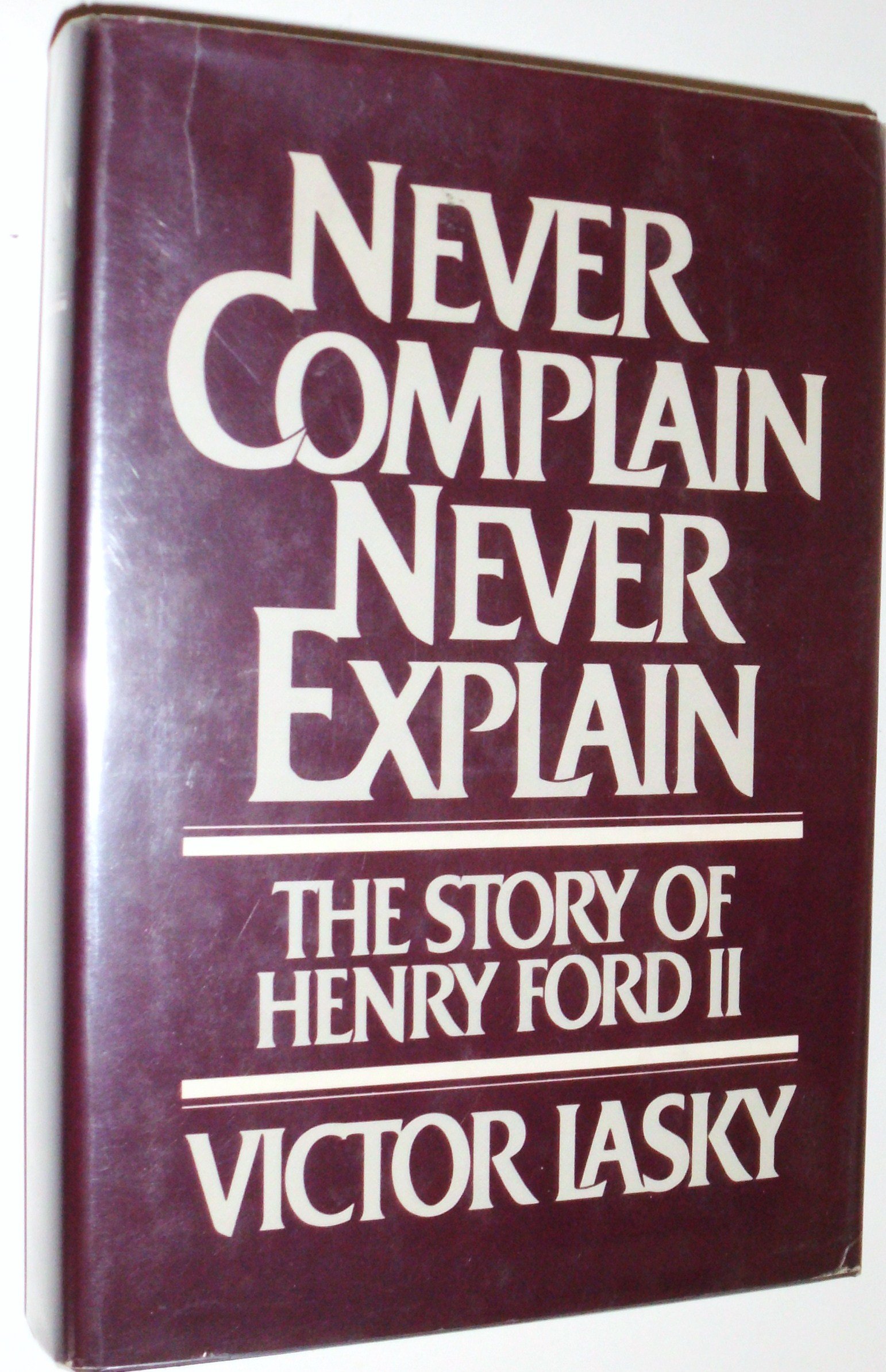
It’s a very Fordian sentiment. In fact I think that Henry Ford once said ‘Don’t Complain, Don’t Explain.’ (Or maybe it was his grandson.) It’s a very assembly-line sort of hyper-utilitarian thinking.

Its cousin is: ‘Actions speak louder than words.’

Well, to be sure, running off a cliff is a very loud action. But nonetheless, methinks you’d much prefer, even the briefest word of warning over your brave action.

A large chunk of what I do is explain things. It’s a significant part of how I intend to make my bread and butter. So, you can see why my jimmies have been rankled enough to produce an entire article, combating this utilitarian philistinism.

That is precisely what I’m doing by the way: combating. I am by no means being defensive. This is an offense. To war!

You see, you self absorbed, day to day, little worker bee drone constantly banging into my garden window with cries of: ‘Talk is cheap!’ No… you’re not as noble as my little honey farmers.

You’re the little aberration of the industrial revolution known as a Morlock, you’ve kidnapped my comically aryan Eloi wench, and I’m the Time Traveler about to dash out your brains.

Why Can’t Americans Teach Their Children How To Think?

I’m as tired of trendy anti-Americanism as any other former Colbert fan. Yet still… Prematurely jaded, know it all, get to the chase utilitarianism is very much an American problem. To be more accurate it is an Anglo problem.

We Englishmen (And yes…Vinny, Morty, and Vlad you’re Englishmen too. Language is culture I’m afraid.) share a common history. We were the most successful children of the Industrial Revolution. It along with the limey penchant for sarcasm, snark, and preening are why sloth and self absorption are at such spectacular heights.

This is why even in the presence of nearly universal education, access to unprecedented amounts of food and shelter (for a spectacular number of folks), and more free time then ever we are still Eliza Doolittle.

GON!

I bet you don’t know what I’m referring to do you?

GON!

What is Pygmalion or it’s back to $7.25/hr, you harridan!

GON!

I bet you haven’t even seen the film, much less bothered with Shaw.

GON!

Back to the gutter with you wretched urchin!

To be honest, I’m not terribly bothered if you aren’t familiar with a very camp movie, about a very old play. It’s just that GON! Is the sound I hear when someone questions the value of thinking.

Imagine a cockney girl trying to say ‘Go On.’ I believe they’re called ‘chavs’ these days. Think of ‘GON!’ Resonating through little piggy, upturned, English noses. Imagine the vocal fry and shudder.

Ghaughowwn!

GON! Is the fizzy pop you get when you bottle provincial arrogance, hot air, and sloth. It’s stupid and proud of it!

What’s up with water. Why should I care?”

GON!

I don’t have time to read. I focus on the important things!”

GON!

I’m an educated man.”

GON!

Well the expert panel said…”

GON!

Talk is cheap.”

GON!

What’s the bottom-line?”

GON!

I really could go on, but in the interest of you hearing something more substantive then my colorful kvetching, I shan’t.

Do Complain, Do Explain

Sorry Henry, old chap, but I must be so decidedly contrarian as to turn your phrase on its head. In fact I’m considering making it the motto of The Fractal Journal. I do believe that America was founded on complaints against out of touch toffs. And I’m willing to bet, that you’d be very eager to have your lawyer, be able to explain, in exquisite detail, that the model-T patent is yours alone.

Absolutely everything requires an explanation. It may not always have to be verbal, but there will always be some sequence of information that an organism is aware of, and comprehends. Comprehending is really silent reading or explaining of a situation to yourself.

The Zen statement: ‘That is a rock,’ is only Zen and profound because the Zen practitioner has trained himself, to allow the universe to explain itself to him.

This is why I find it entirely bizarre, that people are almost proud of their sparse vocabularies, their short attention spans, and their disinterest.

Ennui is only sexy when experienced by young French women. If you aren’t a twenty something bombshell painting in Paris just stop it. You’re bloody annoying.


https://media1.popsugar-assets.com/files/thumbor/4AM3uWuMxA474exrUvoDb-ZYFgE/fit-in/1024x1024/filters:format_auto-!!-:strip_icc-!!-/2011/12/49/1/498/4981322/005e5bfdf5f78983_JULIA-6/i/So-Sexy-Julia-Restoin-Roitfeld-Designs-Capsule-Collection-French-Lingerie-Label-Kiki-de-Montparnasse-See-Her-Model.jpg
Not you.

Why be proud of handicapping your capacity to be human? It is the greatest gift of mankind to be able to perceive, explore, and take joy in knowing.


Why do we instruct writers to dumb things down for readers? Rather than instruct readers to aspire to possess a more nimble mind and vocabulary?

Explaining and comprehending takes time… and we have to go before the mall closes!

Pity.

Explanations are so very intrinsic to being. They are such interesting things. What is a song or symphony but an explanation of the unspeakable?

I think it may be easier to convince you that explanations are worthy things. It may be harder-going promoting the merits of complaints. No one likes a complainer.

Actually, it’s quite easy. Disdain for those who complain is silly. Complaints are simply the explanation for why something is wrong. When you are criticizing someone, merely on the grounds that they are complaining, you are complaining about complaining. How deliciously self defeating.

SO WHAT IN THE SOLEMN HELL DOES ANY OF THIS HAVE TO DO WITH JOURNALISM?”

I can just hear the Engineers and MBA’s seething. Yes, see he has no utility! There’s no bottom line. This article doesn’t do anything. It’s just pretty fluff.

Well, my hypothetical pedants, for all your mechanical brilliance, and shrewd sensibilities you’ve failed to grasp that this entire article is a machine with shrewd purpose, built stringently to spec.

In the span of a mere five pages, ‘I’ve been a traveler of both time and space,’ exposing the liabilities and structural defects, that have led to the decay and disdain of journalism, through the power of the mighty literary device. (Several literary devices TBH. But ‘mighty literary devices’ sounds daft.)

Journalism has value. This is because journalism, when done properly, is simply an interesting way to tell the truth. Telling the truth in an interesting way has intrinsic value. It has intrinsic value because the truth not only sets us free but allows us to: invent, to build accurate models, and cultivate effective strategies and behaviors for surviving, and getting the hell along.

That’s precisely what I’ve done here. I’ve covered a current trend in public sentiment and explained why it’s destructive. I’ve done so in a way that is much more entertaining than if I had merely created a bullet point list, with links to various studies, on the correlation between IQ and vocabulary, and journalism’s role in keeping businesses and governments accountable.

“Ah!” Cry the number crunchers, “But that is where you’re wrong. We’d be much more interested in seeing those!”

Ok,

Sure, it showed a correlation of verbal intelligence and IQ but verbal intelligence is still intelligence. You need to understand things to be intelligent.

Hmm, that last site reeks of GeoCities, but apparently the source is valid. Better link:

These are real world examples of how journalism positively effected society.

This last link is a detailed analysis of the various effects and complications of journalism and media on society and perception.

Happy?

Liars. You don’t want to read that. Especially the highly sciency pubmed study. Because it’s boring. And not only that but it disagrees with your Weltanschauung. The only thing people hate more than being bored, is being bored as it slowly dawns on them, that their beloved ‘science’ (Science is great. ‘science’ isn’t.) is against them.

Total vocabulary has the highest correlation (0.8) with overall IQ of any individual measure of intelligence.

Stings don’t it? Knowing that word wise people are just as intelligent as number savvy ‘hard nosed realists.’ It’s almost like reality has a qualitative as well as quantitative aspect. Whodda thunk it?

Finding important topics, getting an accurate grasp on them, and then presenting them in an interesting light is an art and science, that I am delighted to participate in and champion.

I here consider all Morlocks slain and the merits of journalism thoroughly upheld. Offensively!


Financial Journalist Mark Melin gives examples of journalism’s positive impacts on the Keiser Report: the relevant discussion starts at minute 22.

Water ROI – Psychology, Environment, and Technology (PET)

Image result for efficient water industry

This article is part four of a series.

There is a dangerous delusion in the developed world. It is the delusion that we’ve engineered ourselves out of need. Technology seems to bolster recklessness. When you’re several generations removed from thirst and hunger you tend to believe in endless bounty.

The problem with this blissful nostrum is that there is no such thing as endless bounty. Though we are adept at overcoming limits we are still defined by limits. Perhaps our de facto faith in invincibility is due to the boundary breaking nature of our ingenuity.

This is not a Luddite screed. In fact I feel that technology is as natural and necessary as a meadow of lilacs. However not everything natural is good and lilacs are prone to wilting. Lilacs also grow out of the soil which is in essence a vast graveyard of former lilacs and assorted critters. Technology may be as captivating and integral to life as a lilac field, but the boundaries that were broken, sprang out of beds of deadly error and arduous strain.

Every modern marvel that helps us forget the perilous business of being a creature on earth was hard-won. Take the case of Newtown Creek which is a textbook example of a phenomenon known as ‘Legacy Pollution.’

As the United States and countries the world over were industrializing they were undergoing an unprecedented process. Unprecedented processes have by their very nature unforseen consequences. One unforseen consequence in Newtown Creek was the contamination of the surrounding watershed with various industrial solvents. Solvents that at the time weren’t yet known to be as catastrophic for life as they are. Solvents that cause exotic cancers and environmental degradation . Solvents that are the legacy of early industrialization. Hence the name ‘Legacy Pollutants.’

We still have a problem with pollution and environmental degradation. It is less severe and thus less noticeable. It is something that most of us only take note of when something like the Flint, Michigan event occurs. Though in a way the possibility of taking our resources and technologies for granted is arguably an impressive hallmark of our success, we must never forget that it is a delusion.

We must never forget that it is a delusion because like all delusions it is inherently dangerous. When we forget all the effort that went into maintaining the sanitation, food supply, and luxury that we currently enjoy we are in danger of ‘prosethetic addiction.’

A prosthetic is in this case a technological solution to an environmental issue. Not a bad thing in and of itself. The problem enters in when we get ‘prosthetic addiction’ which is something that is akin to constantly patching a leaky boat with ever dwindling amounts of plaster rather than taking the thing to a dry-dock. ‘Prosthetic Addiciton’ occurs when we think that solutions to pressing problems are quick and easy.

It is the result of a glib acquaintance with history. When you have the luxury of sitting in class to learn about history centuries can become sentences. A paragraph on legacy pollution (something that’s not common core AFAIK) will be a fleeting firing of neurons.

It’s just a few sentences. It’s hard to feel the health lost, the rivers destroyed, and the untold amount of energy that went into damage control in just a few sentences. Even if you do feel it, the feeling soon passes to be replaced by the immediacy of living.

You think about your job, your family, your friends, whether or not you’ll get to play pool Monday night, or if the cute brunette is single. These sorts of thoughts like hunger come unbidden. They are an inescapable part of the bric-a-brac of being human. No one should ever be shamed for them.

Though it may not be shameful to have a glib impression of history, to assume that Elon Musk et al will solve our problems, it is the nonetheless harmful. We should strive to overcome it. We should strive to be informed and aware of the things like water that we all depend upon. We should not outsource these things whole-sale to ‘experts.’

Historical glibness and hero leaning are the chief pillars of ‘prosthetic addiction.’ The cure to the addiction is ever greater attention from ever greater numbers of people. An attention that especially in the democratic republic that is the United States should be vigorously promoted as an implied duty of citizenship.

The first step to dispelling the illusion that all is more or less well, and that the answers to the few problems that remain are just around the corner, is to get some perspective on the limits of resources and good ol’ yankee ingenuity.

The focus in this series is water. Water is a renewable resource. One whose bounty is often overstated. It falls from the sky, sits in vast reserves beneath our feet, and takes up most of the surface of the earth. Why worry?

Well, for one only 3% of the water on earth is fresh and an even smaller percentage of that is readily accessible. Interestingly this comparatively miniscule amount of available water is still large enough to leave us with the aforementioned delusions.

Delusions that become more and more dangerous, as there are more and more people, using more and more resources.

I am a staunch anti-Malthusian. I do not subscribe to misanthropy or the notion that it is impossible for large populations to live well. I do however firmly believe that as more people and industrialization require more resources we must pay more attention to resource use.

That small precious supply of available freshwater that we have, may be renewabl, but is certainly not infinite. If we squander and pollute it the amount of energy and resources that we will have to expend, to do damage control, will have a vast ripple effect in everything from economy to agriculture.

This is not to mention the health and life of people and animals that will be lost from thirst and disease.

A huge cataclysmic environmental catastrophe on a global scale isn’t likely. The very idea itself reeks of the sort of alarmism that turns people off of environmental issues. It is not what concerns me.

What concerns me is lots of little disasters especially ones that are avoidable. Such small disasters like the Newtown Creek incidence alluded to earlier can in aggregate lead to quite a pickle. From conflict over water rights to higher food prices the cost of ignoring these ‘paper-cuts’ can become exorbitant.

As I pointed out in the last article it is fortunate that our steps towards a more efficient use of water seem to have been rewarded. Despite population growth since the eighties our water use has more or less stayed the same.

This happy news is due to advance in technologies and best-practice strategies. Though these technologies and practices have been efficacious we can and must do better.

Needs and populations are increasing and what is adequate now will not be adequate later.

While the technologies and practices currently employed are wonderful they are rather pedestrian fixes.

Many of these fixes have hidden costs. As with all worthy pursuits and processes there are no easy answers. Reviewing water efficiency progress is the best cure for ‘prosthetic addiction’ and its attendant delusions.

Some of the fixes are as dull as making pipes and containers less prone to leaking. Others are as common sense as reusing water for industrial purposes. (http://www.twdb.texas.gov/publications/brochures/conservation/doc/Industrialbrochure-final.pdf)

I am still researching and am sure that I’ll find more interesting examples and stories of responsible water use but I doubt that they’re going to be too terribly exciting. The fact that I have to overcome what I call the ‘boredom barrier,’ doesn’t mean that these aren’t vital pursuits; but does help to highlight why we have difficulty paying sustained attention to ‘mundane’ issues, no matter how important they are.

We may have come a long way since the 80’s but Las Vegas is a city in the desert. The water for this Oasis like many similar southwestern cities has to come from somewhere. This use-case has a litany of side effects that are economic, agricultural, and political.

Clearly there is still a lot of work to be done.

ROI – The Water We Spend

Aerial photo of Beaver Valley Power Station in Pennsylvania, showing evaporation from the large cooling towers.
This article is part three of a series.

“People don’t have any idea that when they flip their light switches on or their air conditioner, there’s huge amounts of water involved,” said Neil Carman, director of the clean air program for the Texas Chapter of the Sierra Club.


Water is behind absolutely everything we do. Let’s begin this story back home. How does our domestic water use break down?

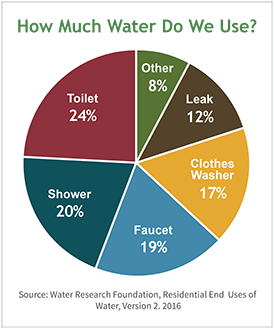
Pie chart of our water use

According to the EPA the average family uses more than 300 gallons of water per day. If you look at the pie chart above (which comes from their website) you can see that we use this water for worthy goals.

Sanitation cannot be overstated. It is what makes life bearable. As such I deem this to be a good ROI for water spending. Though I would stress that we must strive to carry out these use-cases more efficiently.

Efficient use of resources at home is laudable. But we shouldn’t sink into the comforting fantasy that small changes at home will make a big difference for water conservation. The illusion of control that we get from being ‘good people’ is, like most illusions, detrimental.

Even if everybody followed the most stringent conservatism in their domestic water use it wouldn’t begin to make a dent in our ‘water debt’ (To be explained). This is because the biggest water hogs are irrigation and Thermoelectric power.

US Freshwater Withdrawals Chart

As you can see from the above graph almost half of all freshwater withdrawals in 2010 were for Thermoelectric power. Irrigation is the second largest water hog at 32%.

Power and food are essentials. It is a good return on investment to spend water on these things. As with domestic use we must be more efficient here. The efficiencies that we improve in these two areas will have a far greater impact on making sure that we have plenty of fresh water available for the future.

The good news is that we do seem to have had a positive impact on water use.

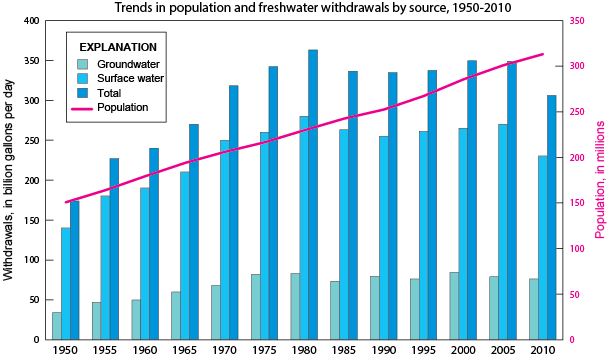
Bar showing showing trends in fresh surface-water use, 1950 to 2010

What the above graph tells us is that there is a relationship between water use and population.

According to this graph water use peaked in 1980. It has since that time remained more or less steady. Though population growth continued along with a greater need for irrigation and industry, total water use has not risen. This seems to suggest that we’ve become more efficient at using water.

While I don’t doubt that greater efficiency in water use has contributed to this pleasant steadiness, I can’t help but think that offshoring a good chunk of our industry may also play a role. (As of the writing of this article I don’t have the exact data but I feel the possibility is worth mentioning.)

Now that you have some idea as to how we use water it’s time to get a bit more in-depth. The next article in this series will delve into the technologies and practices that have allowed us to get more out of water since the 1980’s.


Sources

Applying ‘ROI Thinking’ to Environmental Questions

Image result for the atchafalaya basin


This mini-article could have also been called:

‘Why I Apply ROI Thinking to Environmental Questions’

But it looked awkward in the title bar so I opted for what you see there up top.

So, why apply ‘ROI Thinking’ to environmental questions? Well…

Bottom Line: Money represents resources. If we can use ROI to talk about finance which is a roundabout way of talking resources then we can use it to talk about resources.

So, what is ROI?

It’s a business term that means ‘Return on Investment.’

For the Pedantic:

“Return on investment, or ROI, is the most common profitability ratio. There are several ways to determine ROI, but the most frequently used method is to divide net profit by total assets. So if your net profit is $100,000 and your total assets are $300,000, your ROI would be .33 or 33 percent.”

-Return on Investment(ROI) – Entrepreneur https://www.entrepreneur.com/encyclopedia/return-on-investment-roi

This acronym is useful not just for business but pretty much for everything.

What is it that you get out of the work and resources that you put in?

Some may think this a cynical way of looking at things.

But that’s not an accurate interpretation.

ROI has nothing to do with generosity or stinginess it has everything to do with economy.

If you expend all your energy and resources on something then you may not have that energy and those resources for something more vital.

This is why it is vastly important to pay attention to your return on investment.

So what are some resources that we should be careful with.

Let’s start with the general and important ones:

Time, material, and health.

If you spend all your time with one job or friend then you won’t have any for another.

If you eat all your food and don’t have money then you’re gonna be hungry.

If you ignore your health by sleeping only a couple of hours a night to do XYZ then you won’t be doing XYZ for very long.

This is why you need to pay attention to ROI. Which I will now just call Roy.

Roy is easy to understand but difficult to apply.

Like lots of business terms Roy is basically formal wear for simple ideas.

Roy is about getting as much bang for your buck as possible.

The issue that I’m using Roy to evaluate is an environmental one.

I’m trying to figure out better ways of utilizing the vital resource known as water.

By figuring out I mean describing the problems surrounding water by listening to scientists, journalists, and other professionals and then relaying that information through this journal and coming up with my own ideas.

I’m hoping that in so doing I learn a lot and am able to provide an accurate picture of water issues and possible solutions.

I think that a good place to start is Roy. What are we getting out of the water we spend?

Or it’s counter: what are we losing by spending water in the ways we are now?

‘What are we getting out of the water we spend’ and ‘what are we losing by spending water’ will be the subjects of the next two nonfiction essays in this journal.

Thanks for reading and stay tuned.

ROI Today – Are we productive?

Image result for commute

Take cars, for example. It takes 75,000 gallons of water to produce one ton of steel. Since the average car contains about 2,150 pounds of steel, that means over 80,000 gallons of water is needed to produce the finished steel for one car.


An issue that I will be tackling in upcoming weeks is the amount of resources we spend versus what we produce.

I have had a recurring thought on many a commute that the ratio of products and services rendered versus the cost of production is wildly askew.

Many if not most people drive two tons of steel to and from work  a day. You don’t have to even take carbon into consideration to see why this is potentially wasteful from an ROI standpoint.

First there is the metal itself, then there is the time in production and maintenance, then there is the cost of the fuel. Then there are hidden costs such as the 80,000 gallons of water it takes to produce a car.

Understanding how to balance the ratio of resource use and productivity requires abstaining from finger-pointing and taking a long hard look at what’s actually happening.

My goal is to find out how to produce more than we consume.


Here are some links that can provide insights into the scale of consumption for one very vital resource called water.