
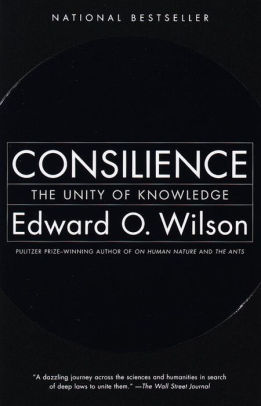
Book Review: Consilience – The Unity of Knowledge (E.O. Wilson)

Consilience: The Unity of Knowledge

Such, I believe, is the source of the Ionian Enchantment: Preferring a search for objective reality over revelations is another way of satisfying religious hunger. It is an endeavor almost as old as civilization and intertwined with traditional religion, but it follows a very different course – a stoic’s creed, an acquired taste, a guidebook to adventure plotted across rough terrain.’

– E.O. Wilson, Consilience – The Unity of Knowledge – Chapter One: The Ionian Enchantment


Introduction to this review: Stray Thoughts Regarding Craftsmanship via – E.O. Wilson’s – Consilience

The Review

Consilience is about consilience, how consilient. That’s the trouble with the word. It’s a bit of a tautology. One of those classifications that point to such a broad phenomenon that it has almost no meaning. It’s like ‘emergent properties.’ Almost everything has or is an emergent property.

I do think these are useful and indispensable concepts. So why do I begin a review by casting aspersions at them?

Well, what’s a review without a bit of taunting and teasing? A touch of play, that’s how you actually keep those austere leather-bound volumes open, rather than having the staid darlings nobly accrue dust on some high shelf.

It is of vast importance to not respect something so much that you never touch it.

For E.O. Wilson the history of humanity, the history of its philosophical, and scientific pursuits has a common thread. Consilience comes from Latin and means something akin to a jumping together. So it is that all knowledge all ken seems to jump together according to a certain logic. It is at such points of convergence that we can become confident in the reality of a given phenomenon and proceed to form a conceptual framework on the basis of this evidence. A conceptual framework which can then be used as a compass to navigate the world of knowledge and make valid predictions. This order this logic is a sort of ‘Ariadne’s thread.’ Allowing us to trace a path through the mysterious labyrinth called cosmos.

Logic itself is a testament to an inherent order that though far more chaotic than the straightforward of ‘fire hot don’t touch,’ is non-the-less intelligible to creatures accustomed to such essential syllogisms.

It is that quest for inherent order for unifying principle that defines the ‘consilience’ concept and serves as the focus of this book.

If one reads the leaflet of the Knopf hardcover edition he discovers a highlighting of this theme:

‘our explosive rise in intellectual mastery’ … ‘has its roots in the ancient Greek concept of an intrinsic orderliness’ …. ‘ a vision that found its apogee in the Age of Enlightenment’

Greece is the focus of the first chapter, in which E.O. Wilson recounts his youthful fascination with the natural beauty of his Alabama home. A fascination that would develop into a sense of mission, the poetically dubbed ‘Ionian Enchantment.’

‘The enchantment’ is a reference to the philosophical outlook of Thales of Miletus, the idea that the universe is intelligible and can be understood once the proper principles are isolated.

One of the great strengths of this book is that Wilson does not let his aesthetic sensibilities cloud his analysis. He readily assents to the difficulty of bottom up analysis, of the synthesis which is at the heart of consilience. Accurately portraying it as a task far more challenging than the more familiar reductionist strategies that have seen much success in the physical sciences.

In Ariadne’s Thread (another Greek allusion) Wilson points out that it is ‘easy’ to go from conceptual complexity to basic physical units. It is an altogether different thing to go from basic physical properties to conceptual complexity.

The myth of Theseus unravelling the ball of Ariadne’s thread in the minotaur’s maze, serves as an apt analogy for humanity’s attempt to make sense of its surroundings. We always find retracing our steps to be easier than finding valid routes through a labyrinth that ultimately has no center.

All we know is that there is something that allows us to navigate, something dear and precious, the yarn of a beautiful maiden that I’m going to take the liberty of identifying with ‘wisdom’ (sic) for the sake of conceptual convenience. This wisdom, this sense of the maze being navigable, is what will eventually allow us something like mastery of that puzzling terrain. Though as Wilson cautions, mastery of such a thing, may not be possible to fully realize.

I’d argue that such an impossibility is actually bliss. It means that the universe is intelligible to just the right degree. So that we may never know enough and grow weary and bored. That greatest joy of exploration will never be yanked from our species.
In fact the more we discover the more the avenues of mystery expand. The future as Wilson points out in the last chapter of his book belongs to synthesizers. People with a sense for consilience who can incorporate information into valid novel coherencies. The universe is thus a vast garden that intelligent creatures like ourselves can eternally cultivate.

This is what makes this book such a worthy read. The rekindling of the classical fire. That flame which was ‘lost’ in recent decades due to the intense specialization that became somewhat inevitable as knowledge and complexity increased.

It is a timely response to the relativism and ‘post modernism’ (sic) of the present age. Which far from providing the fecundity that they seemingly promise have served up something much more akin to stagnation.

I found this book to be a worthy read as a review of the history of science and philosophy through a biologist’s lens. You will encounter in-depth coverage of such perennial issues as nature vs. nurture, the role of genetics in culture, the physical functioning of the brain as it relates to the nature of consciousness, and much more.

The early chapters accounting of the development of the sciences and their underlying methodology has a historian’s flair, that is a timely remedy for the atomization of the knowledge of a ‘common core’ mind.

I’d urge anyone wishing to enrich both their passion and their knowledge to pick up this excellent book.

TAP # 10 – Genussiness – Violin Yoga and Death


Don’t you dare skip my soulful karaoke session!
Did you see that smug look! I thought I was being scholarly. There’s no such word as Genossischkheit as per my web query. Nonetheless I take poetic license and dub this Genussiness which is a word for enjoyment without abandon.


Subjects Discussed 

1) Music and how neat it is that instruments are much more readily available due to financing options like rent to own.

2) ‘Violin Yoga’ or using an instrument to center yourself rather than some esoteric practice or as a complement to your esoteric practice.

3) How learning different instruments are good for getting a better feel for music quicker. IMO.
4) Genussiness – the best way to approach life in the context of the knowledge of death. Which in my opinion is using things like art and music to help you live life to the fullest without the opera buffa of being a ‘tragic artist.’ Enjoyment without abandon. The union of the bridge builder and the painter.
5) The environment through the lens of Michael Crichton’s book State of Fear and E.O. Wilson’s book Consilience.
6) How despite having an art friendly culture it’s often difficult to find work and get along with other artists.
7) An attempt to point out how good things are despite the serious challenges I brought up.

Links ‘n Such
Made to love Magic (Nick Drake) – https://www.youtube.com/watch?v=5D1YS…
Consilience (Book by E.O. Wilson) – https://www.amazon.com/Consilience-Kn…
The Yellowstone Environmental Quagmire – http://www.nytimes.com/1994/06/30/opi…
Violin Rent to Own! – https://www.musicarts.com/

Smell The Bacon

Image result for francis bacon
Francis Bacon (1561 – 1626)

Dedication
For Miss Birdie my very own Eliza…

Has everything been said?

A lot of people presented with a blank page are familiar with this question.

The answer is of course no.

But, let’s for just a moment imagine that the answer is yes. There is nothing new under the sun, all is vanity, and the Simpsons have in fact already done it, twice.

Well, writers would be out of a job wouldn’t they? In fact most professions that rise above agriculture and maintenance would be rendered moot. In short art, philosophy, and a good deal of science would simply die.

Well…Would they? I think not. And I think that’s a beautiful thing. Perhaps even the most beautiful and profound thing about existence.

Allow me to explain.

There is an art all its own in worthy repetition.

It’s an art that’s more recognizable in that trite mantra, “Say it in your own words.”

At its heart it is about comprehension and appreciation. Therein lies its beauty. Therein the solution to Solomon’s eternal ennui.

That solution being the very one the Ecclesiast presented. The solution being finding contentment in that which is. Not that which should be or which could be. Those twin gods of the novelty obsessed. (What devilry novelty is! Teasing and ever tormenting with promises never fulfilled.)

What is the end of mankind but to perceive and enjoy that which is? One needs no faith to appreciate this. It is a truth whose digestion is easy for skeptic and cleric alike.

The fact is, that which is, recurs. Not in exact facsimile but the general patterns are there, with enough fidelity to brand as recurrence.

So recur the things that must be said. Yet their flavor changes. Because those who say it are new. They are new parts assembled from the old, and in reciprocal fashion, these assemble old parts from the new. What a thing it is!

So there is no such thing as a bold new frontier. For what is a frontier, but a thing so ancient, as to be untouched by the novel foot called man?

Yes there is but one art. One sacred art. The art of cultivation. The tending of an eternal garden whose fruits, trees, and flowers blossom of their own accord.

This is the art of Eden.

It sings “I am continuance and I am not to be defined. I am to be enjoyed. To be loved.”

What manifold blossoms what manifold ways! You can sing, you can write, you can etch. You can love and you can direct.

When one is sated on such fruits why should she reach for the forbidden thing called ‘Define.’

Perhaps it was God’s end to make mankind because Godhood is over-rated. Perhaps there is a Hell and it is called Completeness. What Good would a Good Lord be if He doomed His creatures to such a Fate from the outset?

The art of worthy repetition occurred to me today when I came across a rendering of the thoughts of Francis Bacon.

The thing occurred as I am rereading the springboard for my current project, E.O. Wilson’s Consilience, The Unity of Knowledge.

‘Look at that!’ I said. That is precisely what I’ve been meaning to say and it was said so well four hundred years ago! What business have I prattling on? Dejection creeped upon me.

Till I realized: If I’ve just had my thoughts echoed from a distance of four centuries… why not become an echo?

Because it is a worthy thing that I wish to Magnify…

The Father of Induction saw fit to say that the mind,

“is not like a wax tablet. On a tablet you cannot write the new till you rub out the old; on the mind you cannot rub out the old except by writing in the new.”

What an altogether compact and lovely way to say everything that I have said above!

Yet, Bacon said much more that I have wished to say, and will echo here today.

He saw the importance of psychology. Saw it as being of utmost use for effective science and creativity. Even though the word had not been codified, he understood the value for getting a grasp on the mechanisms of mind. This is precisely what I have been stressing, and meaning to stress better, by positing that the first and foremost of lenses is perception itself. One that must be polished and studied with more caution than any other science.

Sir Francis Bacon also cautioned of the ‘idols of the mind.’ My, what a way to warn against those perils which have so vexed me to espy ahead, behind, and all around. What a fitting term is ‘idol’ for this idolatry! For taking living truths and turning them into wooden follies.

  • The first is the idol of the tribe. That thing that superimposes an artificial, constricting order, where there is a natural ‘chaos.’

  • The second is the idol of the cave, which is subjectivity. Personal prejudice falsely enshrined as objectivity.

  • The third is the idol of the marketplace, or of a marketers ability to sell a fantasy, through persuasion.

  • The fourth idol, and the one that I believe to be most dangerous of all today, is the idol of the theater! It is the most dangerous because the manufacturing of consent, and every other thing, is today done largely through entertainment; whether consciously or unconsciously. Our attitudes and beliefs, are molded by engaging all our senses in films, television and radio programs, and much else in the world of multimedia. We must be therefore sharply on guard, for what follies we may have unwittingly taken on board. For in such a world, such harboring of error, is exceedingly easy and common. Broad is the way, BROADWAY, to destruction indeed!

I am very glad to have stumbled upon Wilson’s book. An event that is now three years old. I am very glad that I have had the good sense to remember the book, to use it as a springboard, and most of all to give it a second reading. Yes, the repetition was as sweet as the first taste.

I am very glad that Wilson has done the indispensable work of making thick and hoary volumes accessible. I am glad that he has echoed ‘The Ionian Enchantment.’

I am glad to have heard that echo of Bacon, echoed by Wilson, and to echo it in turn.

This is how we must garden.

For truly, we are all but gardeners, upon the terraces of an eternal Eden.

Wake up and smell the Bacon!


Support Indie Content: https://www.patreon.com/TheFractalJournal