One of the biggest problems in society is oversimplification. With better tech and more information we’re doing it more and quicker than ever before – with ‘sciencey’ words like ‘Dopamine.’
While Dopamine is a real neurotransmitter, the way that it’s implicated in absolutely everything is indicative of the trend of dangerous and annoying reductionist psychobabble.
The article referenced: https://www.psychologytoday.com/blog/women-who-stray/201701/no-dopamine-is-not-addictive
I’m launching a series that’s kinda philosophical in nature. Feels a bit pompous to say that but that really is it: a feeflowing foray into methods and philosophies and what they can teach us about the world.
I’m not attempting to shed any kind of new light here. Though if that happens in an emergent way that’s swell. There are two reasons for doing philosophy or any kind of analysis in my opinion:
1) To discover some new truth
2) Maintenance – understanding why what you know is true, and sharpening your abilities to discern truth and effective philosophies/methods
I will primarily be doing the latter. I think it more important in the same way that exercising regularly is more important than trying to max out.
Today’s Topic
Generalities and Specifics
When you analyze anything – you do so in either a general or specific way – in a microcosmic or macrocosmic scope.
You either see the forest or the trees.
This well-known concept called perspective bears visiting and revisiting.
That’s the curious thing about philosophy, whenever you run its various algorithms, you come up with iterations that are either entirely new or new to yourself. Which if you’re paying attention will inevitably lead to a deeper appreciation of life and perhaps augmented faculties.
Sort of like expanding your verbal vocabulary will allow you to know more, to express more, the study of philosophy and method: will allow you to know what you don’t know which in a curious reversal will allow you to know more truly.
The hunt for veracity, the pruning of the wild garden of concept, history, and method begins with perspective. It begins with generalities and specifics.
Why come up with these words. Why not just say perspective?
Well, I think that it’s important to highlight the sketching nature of inquiry. It’s not a laserlike, precise, engineering, sort of thing; at least not most of the time. Seeing that the general can be specific and the specific can be the general – will allow the sort of flexibility which will eventually provide the strength of sinew and ligament requisite for the precise and utilitarian glory of a piston or microprocessor.
That is the thing that seems to be forgotten more and more as more and more generations are undergoing the sterile process of common core. Philosophy, you see, is the forefather of mathematics, which is the forefather of science, which is the forefather of the technique that allows for 4g streaming. We seem to have let this fact get a tad dusty.
All these disciplines are various levels of generalities and specifics and often intertwine. Philosophy and mathematics must still be applied to the theories derived from the data derived from the scientific method. Here again is evidence of the fractal nature of inquiry of generalities and specifics.
Philosophy is perhaps the most general brush. The thing that allows us to set the scene, to paint in the background.
The unfortunate thing is that it has gotten a bad name. And it has gotten a bad name because many of its practitioners forget that they are sketching. I’m not at the present talking about the various schools and professional philosophers that you will encounter in any given Philosophy 101 course.
I’m talking about conversation.
I am talking about conversation because everyone does philosophy. Conversation as long as it strays beyond the weather and favorite flavors of ice cream will eventually take a philosophical turn. In fact, one can look at the entire history of inquiry as basically one continuous conversation facilitated by the advent of the printing press, and prior to that, the traditions and practices of various conservatories both secular and religious.
I am not only talking about conversation in general but a more specific type of conversation known as public discourse.
General conversation leads to the specific conversation of public discourse which leads to various societal, technological, legal, artistic, and historic outcomes that are either glorious or tragic.
In a society of frantic actors who all believe themselves to be put upon entrepreneurs, conversation can also get a bad name – And it can get a bad practice.
Empty talk! Actions speak louder than words! Etc. ad naseum.
Well, supposing I told you that there’s a cliff you’re about to fall off, then the value of words will certainly become aparent, and quickly!
Actions are certainly more exciting than conversation and often times more efficacious. Since direct experience at times allows you to learn far more than poring over the most erudite tome, of the most illustrious thinker.
Yet when you’ve had the experience you must be able to contextualize it, in order to more effectively remember it, to be able to share it with others and to know what of the experience was real.
It is here that conversation goes awry because most people don’t contextualize their experiences, they don’t classify it into generalities and specifics very effectively, and share it in a raw sort of form.
This report of impressions while initially useful will if not expounded and improved upon with the rigorous methods of philosophy and logic, eventually lead to faulty conclusions and reinforced biases.
This is why today as always it is painfully apparent that most people, even cautious people, myself included, more often than not simply exchange talking points, and return quickly to the comforting arms of prosaics like: which beer?
One shouldn’t try to force deeper conversations. One should not make it a chore. The thing I am calling for is to be aware of where on the ‘generalities and specifics’ spectrum you find yourself during conversation. This is a call for being better aware of when exactly you are engaging in pundit style banter and smalltalk and when you’ve hit upon something profound.
This ability hinges on the capactiy for philsophy something that arises from a combination of knowledge and practice.
Philosophy is really method, or rather philosophy is the ur-method which allows you to form new methods with structural integrity.
What I am calling for is some reading, is some thinking, is some attention. All thigns which should provide you with the realization that most of your conclusions are lacking. That conversations, ideas, and actions dervied from lacking conclusions will compound into an obfuscating cloud that may compromise your ability to enjoy life and see truth.
It is a difficult thing, that begins with a more careful examination of generalities and specifics of who, what, where, and how? Of words like any, many, some, always, never, etc.
It is a difficult thing that I myself don’t always live up.
Here is an admitedly dry and somewhat impenetrable little volume that may, given some patience, give you a start.
In this TFJ Vlog, you will find a discussion of the need to develop physical and metaphysical stamina. Public discourse and effective inquiry require strength and character. Both of these are inextricably tied and I give some quirky examples of how to attain them.
Mortality and the prosaic nature of megadeath are mentioned as a call to greater vigor and reverence for the potential lost.
There is also some discussion of the environment, especially water, and agriculture and how profoundly it affects our lives.
Due diligence must be given to such weighty issues and I just don’t see it being done on a large enough scale. So I raise the need for a more public engagement.
Recent conversations have me realizing the need to try to begin to hammer out a topic that’s been on my mind for a while: the difference between advocacy and reporting.
Understanding the merits, methods, and problems of both disciplines is especially necessary in the information-saturated society of today.
I also talk about the merits of Linux and give some reasons for and against using it from a content creators perspective.
LOL. That thumbnail tho. I couldn’t resist…wut will they say bout us ma! We must attain Linux Purity!
There is some salty language briefly. It is included because it is how some people talk. Skip it if you’re offended. There’s lots of content here.
Edward R. Murrow
Don’t Be Defensive
I’m always going to remember sitting in my techie friends small office bedroom, on the big medicine ball, serving as the only available guest chair. There was no bed. Simply a hammock and two high powered PCs. I’m always going to remember it because it’s damned quirky.
I’ve been meaning to learn Java since I found out about it around 2007. I didn’t have the knack for it, but I’m stubborn, so I still have that goal on the back-burner to this very day, a full decade later.
I’ve made some modest progress, over the last couple of years towards that end. I’m a writer so I’m a narrative guy (Learn through/Thrive on: stories), so careful reading, and lots of web queries on background info were my go to.
Slowly but surely, through lots of notes on the free tutorial provided by HWS, and Niemeyer & Leuck’s: Learning Java; I’ve been able to absorb enough basic principles to where I don’t feel completely lost, as I feed bad code into NetBeans.
It was my geeky reading habits, and the opportunity to exchange off-color jokes that found me in the strange little blue room.
We were having a discussion on the strengths and weaknesses of various programming languages.
There was a stack of programming manuals on the desk. I asked about C++ and the book. And then somehow, the conversation turned to the creator of the language, and author of that particular volume: Bjarne Stroustrup.
“O he’s a little bitch.”
I thought this odd.
“That book…it’s …he’s just…”
I really didn’t have a comment. But not for any nobler reason than sheer ignorance.
“He’s just such a defensive little bitch.”
“How so?”
“It’s just he goes on and on…just complaining…he’s almost whiny…like I can’t stand it. You shouldn’t have to explain why something is good, he just comes off as super insecure, it’s a pain in the ass to read.”
“Well,” I said as my writer’s sympathy kicked into high gear, “critics are assholes, often dishonest assholes, dishonest partisan assholes, and I bet a buncha C Nazis were giving him hell, I don’t think addressing criticisms and misunderstandings is defensive.”
“Eh…yeah…but the way he does it. It’s just…cringy. You should just make something so good that you don’t have to explain why it’s good.”
“Yeah, but what if ya did, and a buncha schmendricks picked it apart, and just painted a totally inaccurate picture of it…”
“Yeah, I get that, but it’s just not as good of a book as it could have been if he wasn’t so fuckin’ whiny. And like…you should make something so good…that no one can say shit about it. Period.”
This conversation went on for a while, it is one that I’ve committed to memory, as it’s indicative of a certain attitude that needs addressing. It is an attitude that I find to be common among techies, medical professionals, and business-people. It’s a certain overdeveloped minimalism that breeds error, haughtiness, and hypocrisy.
‘Actions Speak Louder Than Words’
My friend isn’t stupid. The idea that you can create something that’s unassailably good, was just a result of the hyperbolic way we talk. If such a thing as perfection existed, I think that human beings would still find ways to fault it.
What I found staggering about my conversation is that, there was that element of ‘you shouldn’t have to explain things.’
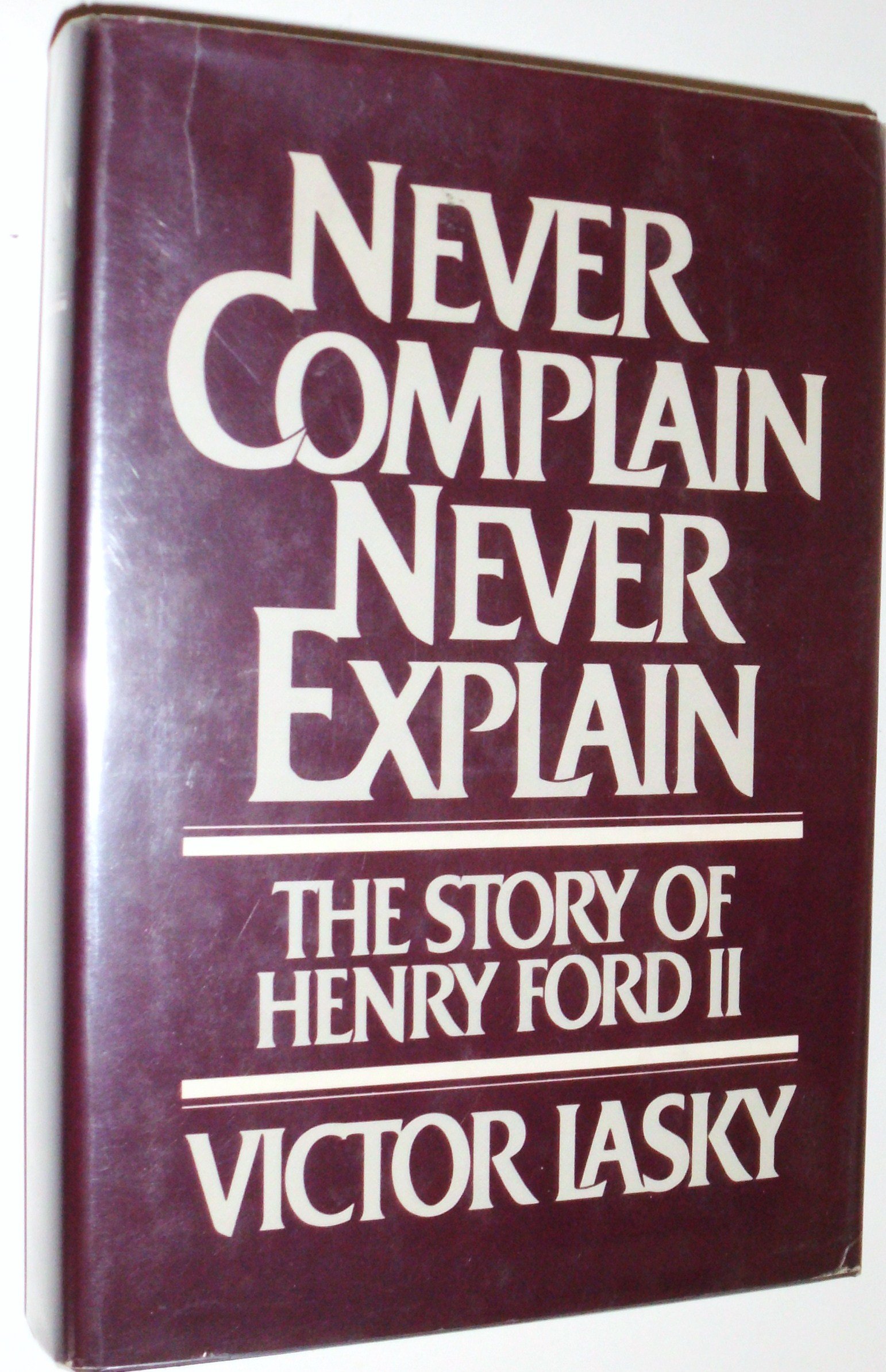
It’s a very Fordian sentiment. In fact I think that Henry Ford once said ‘Don’t Complain, Don’t Explain.’ (Or maybe it was his grandson.)It’s a very assembly-line sort of hyper-utilitarian thinking.
Its cousin is: ‘Actions speak louder than words.’
Well, to be sure, running off a cliff is a very loud action. But nonetheless, methinks you’d much prefer, even the briefest word of warning over your brave action.
A large chunk of what I do is explain things. It’s a significant part of how I intend to make my bread and butter. So, you can see why my jimmies have been rankled enough to produce an entire article, combating this utilitarian philistinism.
That is precisely what I’m doing by the way: combating. I am by no means being defensive. This is an offense. To war!
You see, you self absorbed, day to day, little worker bee drone constantly banging into my garden window with cries of: ‘Talk is cheap!’ No… you’re not as noble as my little honey farmers.
You’re the little aberration of the industrial revolution known as a Morlock, you’ve kidnapped my comically aryan Eloi wench, and I’m the Time Travelerabout to dash out your brains.
Why Can’t Americans Teach Their Children How To Think?
I’m as tired of trendy anti-Americanism as any other former Colbert fan. Yet still… Prematurely jaded, know it all, get to the chase utilitarianism is very much an American problem. To be more accurate it is an Anglo problem.
We Englishmen (And yes…Vinny, Morty, and Vlad you’re Englishmen too. Language is culture I’m afraid.) share a common history. We were the most successful children of the Industrial Revolution. It along with the limey penchant for sarcasm, snark, and preening are why sloth and self absorption are at such spectacular heights.
This is why even in the presence of nearly universal education, access to unprecedented amounts of food and shelter (for a spectacular number of folks), and more free time then ever we are still Eliza Doolittle.
GON!
I bet you don’t know what I’m referring to do you?
GON!
What is Pygmalion or it’s back to $7.25/hr, you harridan!
GON!
I bet you haven’t even seen the film, much less bothered with Shaw.
GON!
Back to the gutter with you wretched urchin!
To be honest, I’m not terribly bothered if you aren’t familiar with a very camp movie, about a very old play. It’s just that GON! Is the sound I hear when someone questions the value of thinking.
Imagine a cockney girl trying to say ‘Go On.’ I believe they’re called ‘chavs’ these days. Think of ‘GON!’ Resonating through little piggy, upturned, English noses. Imagine the vocal fry and shudder.
GON! Is the fizzy pop you get when you bottle provincial arrogance, hot air, and sloth. It’s stupid and proud of it!
“What’s up with water. Why should I care?”
GON!
“I don’t have time to read. I focus on the important things!”
GON!
“I’m an educated man.”
GON!
“Well the expert panel said…”
GON!
“Talk is cheap.”
GON!
“What’s the bottom-line?”
GON!
I really could go on, but in the interest of you hearing something more substantive then my colorful kvetching, I shan’t.
Do Complain, Do Explain
Sorry Henry, old chap, but I must be so decidedly contrarian as to turn your phrase on its head. In fact I’m considering making it the motto of The Fractal Journal. I do believe that America was founded on complaints against out of touch toffs. And I’m willing to bet, that you’d be very eager to have your lawyer, be able to explain, in exquisite detail, that the model-T patent is yours alone.
Absolutely everything requires an explanation. It may not always have to be verbal, but there will always be some sequence of information that an organism is aware of, and comprehends. Comprehending is really silent reading or explaining of a situation to yourself.
The Zen statement: ‘That is a rock,’ is only Zen and profound because the Zen practitioner has trained himself, to allow the universe to explain itself to him.
This is why I find it entirely bizarre, that people are almost proud of their sparse vocabularies, their short attention spans, and their disinterest.
Ennui is only sexy when experienced by young French women. If you aren’t a twenty something bombshell painting in Paris just stop it. You’re bloody annoying.
Why be proud of handicapping your capacity to be human? It is the greatest gift of mankind to be able to perceive, explore, and take joy in knowing.
Why do we instruct writers to dumb things down for readers? Rather than instruct readers to aspire to possess a more nimble mind and vocabulary?
Explaining and comprehending takes time… and we have to go before the mall closes!
Pity.
Explanations are so very intrinsic to being. They are such interesting things. What is a song or symphony but an explanation of the unspeakable?
I think it may be easier to convince you that explanations are worthy things. It may be harder-going promoting the merits of complaints. No one likes a complainer.
Actually, it’s quite easy. Disdain for those who complain is silly. Complaints are simply the explanation for why something is wrong. When you are criticizing someone, merely on the grounds that they are complaining, you are complaining about complaining. How deliciously self defeating.
“SO WHAT IN THE SOLEMN HELL DOES ANY OF THIS HAVE TO DO WITH JOURNALISM?”
I can just hear the Engineers and MBA’s seething. Yes, see he has no utility! There’s no bottom line. This article doesn’t do anything. It’s just pretty fluff.
Well, my hypothetical pedants, for all your mechanical brilliance, and shrewd sensibilities you’ve failed to grasp that this entire article is a machine with shrewd purpose, built stringently to spec.
In the span of a mere five pages, ‘I’ve been a traveler of both time and space,’ exposing the liabilities and structural defects, that have led to the decay and disdain of journalism, through the power of the mighty literary device. (Several literary devices TBH. But ‘mighty literary devices’ sounds daft.)
Journalism has value. This is because journalism, when done properly, is simply an interesting way to tell the truth. Telling the truth in an interesting way has intrinsic value. It has intrinsic value because the truth not only sets us free but allows us to: invent, to build accurate models, and cultivate effective strategies and behaviors for surviving, and getting the hell along.
That’s precisely what I’ve done here. I’ve covered a current trend in public sentiment and explained why it’s destructive. I’ve done so in a way that is much more entertaining than if I had merely created a bullet point list, with links to various studies, on the correlation between IQ and vocabulary, and journalism’s role in keeping businesses and governments accountable.
“Ah!” Cry the number crunchers, “But that is where you’re wrong. We’d be much more interested in seeing those!”
Sure, it showed a correlation of verbal intelligence and IQ but verbal intelligence is still intelligence. You need to understand things to be intelligent.
This last link is a detailed analysis of the various effects and complications of journalism and media on society and perception.
Happy?
Liars. You don’t want to read that. Especially the highly sciency pubmed study. Because it’s boring. And not only that but it disagrees with your Weltanschauung. The only thing people hate more than being bored, is being bored as it slowly dawns on them, that their beloved ‘science’ (Science is great. ‘science’ isn’t.)is against them.
Total vocabulary has the highest correlation (0.8) with overall IQ of any individual measure of intelligence.
Stings don’t it? Knowing that word wise people are just as intelligent as number savvy ‘hard nosed realists.’ It’s almost like reality has a qualitative as well as quantitative aspect. Whodda thunk it?
Finding important topics, getting an accurate grasp on them, and then presenting them in an interesting light is an art and science, that I am delighted to participate in and champion.
I here consider all Morlocks slain and the merits of journalism thoroughly upheld. Offensively!
Financial Journalist Mark Melin gives examples of journalism’s positive impacts on the Keiser Report: the relevant discussion starts at minute 22.





 The Fractal Journal
/Josephine/shot0072.jpg)
